Wealth & Leadership
You're Too Creative to Stay Broke:
Why Visionary Founders Must Build Wealth and Community Power
The future belongs to creators who learn how to monetize their creativity, build systems around their ideas, and transform vision into lasting institutions. Talent starts the journey. Structure creates wealth.
There are too many brilliant creatives, organizers, and visionary founders living with the wrong story in their heads.
They believe they have to choose between purpose and prosperity. Between helping their community and building real wealth. Between being respected for their ideas and being paid for the value they create.
That belief keeps talented people stuck.
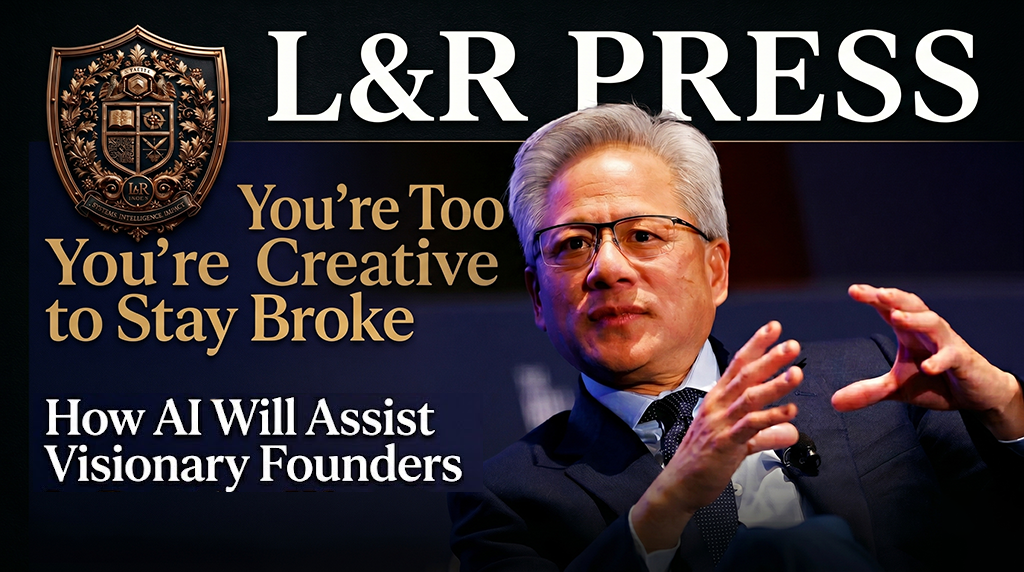
NVIDIA CEO Jensen Huang recently predicted that artificial intelligence will create more millionaires in the next five years than the internet created in two decades. His argument is simple: AI is becoming the great equalizer. It gives creators, founders, artists, and entrepreneurs access to capabilities that once required entire teams, specialized expertise, or significant capital.
For creatives, this represents a historic opportunity. The barrier is no longer access to tools. The barrier is knowing how to organize ideas, validate demand, build systems, and turn creative work into something people will actually pay for.
If you have vision, influence, cultural intelligence, taste, and the ability to move people, you are already holding something rare. But creativity alone is not enough. Talent is not the same as monetization. Vision is not the same as structure. And community respect, by itself, is not the same as institution-building.
You are too creative to stay broke.
You are too gifted to remain under-structured, underfunded, and underpaid while less visionary people build organizations, attract capital, and shape the future of the communities you care about.
The next step is not simply working harder at your craft.
The next step is learning to think like an executive.
Creativity and monetization are different skill sets
One of the biggest mistakes talented people make is assuming that if they are brilliant enough, the money will eventually come.
Sometimes it does. Many times it does not.
That is because being creative and monetizing creativity are two different skill sets.
Creativity helps you
- • Imagine
- • Design
- • Inspire
- • Communicate
- • Connect
- • Move people emotionally
Monetization requires
- • Packaging
- • Positioning
- • Pricing
- • Systems
- • Funding strategy
- • Audience conversion
- • Operational discipline
- • Long-term execution
That gap explains why so many brilliant people remain financially stuck while less talented people build wealth.
"Escape competition through authenticity."
— Naval Ravikant
Authenticity creates differentiation. But differentiation alone does not create an institution. Structure turns originality into income, leverage, and long-term power.
L&R Press Portal Insight
This is where many creatives get stuck.
They have talent.
They have followers.
They have ideas.
But they do not have a system that turns creativity into revenue.
Jensen Huang believes artificial intelligence is creating unprecedented opportunities for creators to generate wealth. We agree. But opportunity alone is not enough. Creatives still need systems that transform ideas into products, audiences into customers, and vision into execution.
The L&R Press Client Portal was designed to help bridge that gap. It helps founders organize market research, customer feedback, funding opportunities, strategic priorities, partnerships, and next steps into a single operating system. Instead of relying on memory, scattered notes, endless brainstorming sessions, and disconnected software tools, creatives gain a structured pathway for turning ideas into products, services, programs, partnerships, and sustainable income.
The goal is not simply to create more.
The goal is to create something valuable enough, organized enough, and scalable enough to generate lasting wealth.
How creatives build wealth without abandoning their values
Many visionary founders, especially those rooted in underserved communities, have been taught to distrust wealth.
They have absorbed the idea that making money somehow weakens their purpose. That leadership should always look sacrificial. That helping people means constantly undercharging, overgiving, and exhausting yourself.
That mindset is not noble. It is unsustainable.
If your work creates real value, then building wealth around it is not betrayal. It is stewardship.
You need money to:
- Build programs
- Hire strong people
- Create systems
- Stay consistent
- Survive slow seasons
- Scale real impact
"When you undervalue what you do, the world will undervalue who you are."
— Oprah Winfrey
That is not just personal advice. It is an operating principle. If you underprice your leadership, under-structure your organization, or refuse to build a serious financial model, you reduce your ability to lead.
Should a creative founder build a nonprofit or a for-profit?
Once a creative founder begins thinking seriously about wealth, leadership, and community impact, the next question is not just how to get paid.
The next question is what kind of structure actually fits the work.
Not every visionary should build a nonprofit.
Not every community-minded founder should build a business.
And not every creative leader is wired for the same kind of institution.
The right structure depends on your goals, your personality, your relationship to money, and the kind of impact you want to create.
A nonprofit structure may be the right fit if you are
- Deeply mission-first
- Focused on underserved communities or public benefit
- Motivated by service, systems change, education, housing, workforce, reentry, health, or civic outcomes
- Willing to work with boards, compliance requirements, grant funding, and public accountability
- Interested in building something that can attract donations, grants, sponsorships, and institutional partnerships
- Comfortable leading an organization where the mission must remain bigger than personal ownership
This structure tends to work best for founders who want to build community institutions, public-serving programs, and long-term impact platforms.
A nonprofit can be powerful if your real goal is to build something fundable, credible, and rooted in public good, while still creating a legitimate executive role and salary.
A for-profit structure may be the right fit if you are
- Highly entrepreneurial
- Product-driven
- Motivated by ownership, scale, pricing freedom, and direct market response
- Building something that solves a problem people or organizations will pay for directly
- More comfortable with sales, customer acquisition, and private control
- Interested in building assets, equity, and unrestricted revenue without the governance structure of a nonprofit board
This structure tends to fit founders who want speed, control, flexibility, and a more direct relationship between value created and money earned.
A for-profit can be the better choice when the founder's work is more naturally a service, product, platform, consultancy, agency, or venture-backed solution.
Some founders are actually hybrid thinkers
Some of the most powerful creative leaders are not purely nonprofit or purely for-profit in how they think.
They want:
Those founders often need help deciding whether to:
- Start with a nonprofit
- Start with a business
- Build a business that supports a mission
- Or eventually operate across multiple entities
The point is not to pick the structure that sounds morally impressive.
The point is to pick the structure that best supports the mission, the founder, and the long-term model.
Personality matters more than people admit
A founder who thrives in community accountability, coalition-building, and public trust may do very well in a nonprofit structure.
A founder who thrives in ownership, speed, market responsiveness, and independent control may struggle in a nonprofit environment and perform better in a for-profit structure.
Neither is automatically more ethical.
Neither is automatically more serious.
The real question is which environment allows you to lead well, build sustainably, and stay aligned with the kind of future you are trying to create.
That is why structure is never just a legal decision. It is a leadership decision.
Can nonprofit founders make money?
This is one of the biggest questions creative and community-minded founders ask, even when they do not say it out loud.
Yes, nonprofit founders can be paid.
A nonprofit is not supposed to exist for private enrichment, but it absolutely can and should compensate leadership fairly when the organization is real, active, compliant, and delivering public benefit.
The deeper issue is not whether founders can make money.
The real issue is whether the founder is building something structured enough to:
- Raise money responsibly
- Support executive compensation ethically
- Create measurable impact
- Sustain operations over time
Many people have the heart to serve but never build the financial or institutional structure required to make that service durable. That is where most promising founders get stuck.
How to build a community organization that creates both impact and income
If you want to help your community and create wealth, you need to stop thinking only in terms of talent and start thinking in terms of infrastructure.
That means asking:
- 1Should this be a nonprofit, a for-profit, or a hybrid?
- 2What exactly is the mission and who does it serve?
- 3What problem is urgent enough that people will fund it?
- 4What is the first real offer, service, or program?
- 5What systems support growth?
- 6How does leadership get paid ethically and sustainably?
- 7What partnerships or funders are needed to scale?
These are executive questions. And serious founders ask them early.
The people who build lasting organizations are not just artists, speakers, creators, or idea generators. They become builders of systems, partnerships, and institutions.
L&R Press Client Portal
Your Vision Needs More Than Motivation
The Client Portal gives founders the Mission Ladder, structure, and built-in operator support that turn creative vision into a fundable, executable organization.
Build My Mission LadderVisionary founders must think like executives
If you are a founder with talent, trust, and ideas, then your next evolution is not just more creativity.
It is executive discipline.
That means learning how to:
- Structure an organization
- Communicate clearly with funders and stakeholders
- Build a public-facing offer
- Create pathways for revenue and support
- Make smart decisions about legal structure
- Lead something bigger than your personal brand
"I'm not a businessman, I'm a business, man."
— Jay-Z
That line stays powerful because it speaks to identity. If you think of yourself only as a creative person with talent, you will often keep operating informally. If you begin to see yourself as the builder of an institution, you start making different decisions.
Why visionary founders stay broke
Most visionary founders do not stay broke because they lack intelligence or talent.
They stay broke because they stay under-structured.
A great creative without monetization becomes frustrated.
A great community idea without funding becomes fragile.
A great founder without systems becomes overwhelmed.
The problem is usually not the vision. The problem is the absence of structure around the vision.
Once structure enters the picture, the possibilities change. Now the vision can become:
- A nonprofit
- A social enterprise
- A funded initiative
- A public-private partnership
- A community development platform
- A long-term institution that creates both income and impact
That is the shift from expression to infrastructure.
Final thought: your creativity should build more than attention
You are too creative to stay broke. And you are too needed to stay small.
Your community may not just need your art, your message, or your personality. It may need your leadership, your systems, your institution, and your willingness to build something strong enough to last.
The goal is not to choose between wealth and impact.
The goal is to build the structure that makes both possible.
How L&R Press Solves This Problem
The gap between visionary creativity and durable wealth is rarely a talent problem — it's a structure problem. The L&R Press Client Portal gives founders the operating system they've been missing, so creative vision becomes a fundable, executable, institution-grade organization.
1. Mission Ladder turns vision into priorities
Your goals are translated into a sequenced Mission Ladder — the few decisions and deliverables that actually move the organization forward, instead of a long unfocused to-do list.
2. Structure decisions made in the open
Choose nonprofit, for-profit, or hybrid with guided frameworks built into the portal — so legal structure, funding model, and leadership compensation are decided early, not improvised later.
3. One operating record instead of scattered information
Tasks, decisions, partners, funders, and meeting notes live in one accountable workspace — so the organization stops running on memory, group chats, and goodwill.
4. Execution support, not just advice
Every engagement begins with a paid working session and continues with built-in operator support, so founders move from concept to institution with real follow-through.
What's next
Turn your powerful idea into a real organization.
L&R Press helps leaders build the structure, positioning, funding readiness, and execution strategy needed to move from concept to institution.
Get Started