Mission Ladder & Operational Strategy
What Raising Cane’s Taught Us About Building the Mission Ladder
Why L&R Press studied a chicken finger restaurant to build a consulting company.
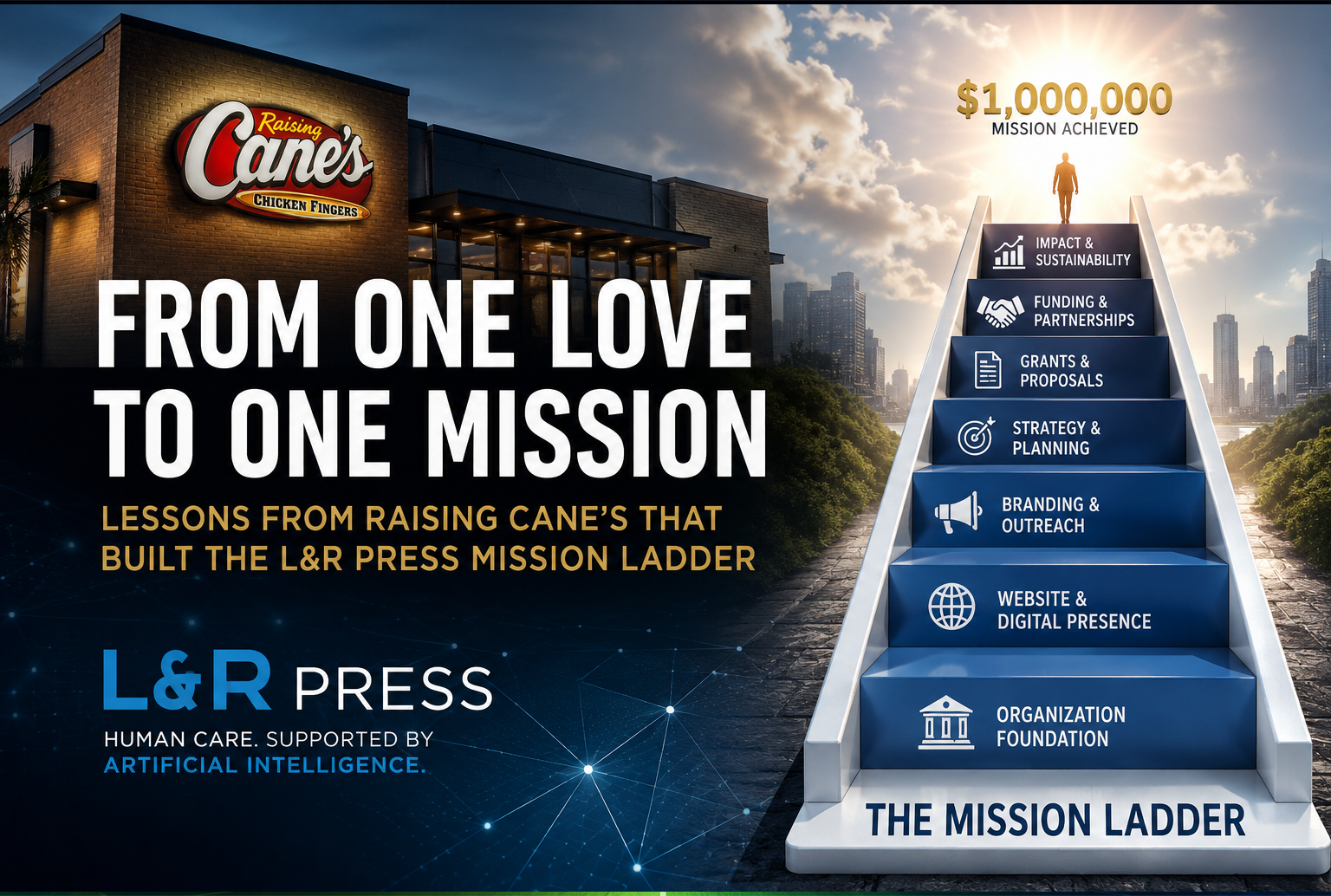
Why L&R Press Studied a Chicken Finger Restaurant to Build a Consulting Company
Most consultants study consulting firms.
We studied Raising Cane’s.
At first glance, that sounds ridiculous.
One company sells chicken fingers.
The other helps organizations raise funding, launch initiatives, execute strategic plans, and scale impact.
But when we looked deeper into the rise of Raising Cane’s founder Todd Graves, we realized he had solved the same problem that destroys most organizations:
Complexity.
And complexity is the silent killer of execution.
Today, Raising Cane’s has grown from a business plan that received a mediocre grade and was repeatedly rejected by investors into one of the fastest-growing restaurant brands in America, with more than 900 locations and billions in annual revenue.
The lesson wasn’t about chicken.
The lesson was about focus.
The Most Important Business Strategy Nobody Wants to Hear
Most organizations have too many priorities.
Too many initiatives.
Too many committees.
Too many meetings.
Too many software platforms.
Too many people doing work that doesn’t move the mission forward.
Todd Graves did the opposite.
Instead of trying to become another fast-food restaurant serving burgers, salads, wraps, desserts, breakfast, and seasonal menu items, Raising Cane’s became obsessed with doing one thing exceptionally well:
Chicken fingers.
The company built an entire operating system around a single mission. That is the same idea behind a Living Business Operating System.
Not ten missions.
One mission.
The result was operational clarity that could scale.
When we began studying high-growth organizations, we saw the same pattern repeatedly.
The most successful organizations are not necessarily the most talented. They are the most aligned.
L&R Press Portal Insight
The most successful organizations are not necessarily the most talented. They are the most aligned.
This is the principle behind the Mission Ladder: reduce complexity, define the mission, identify the next rung, and keep the entire organization moving in the same direction.
The Real Problem Isn’t Lack of Strategy
One of the biggest myths in business is that organizations fail because they don’t have a strategy.
Most organizations have plenty of strategy.
They have strategic plans.
Board retreats.
Consultants.
Vision statements.
Roadmaps.
PowerPoints.
What they don’t have is execution.
At L&R Press, we noticed that clients weren’t struggling because they lacked ideas.
They were struggling because nobody owned the system as a system.
The grant writer was doing one thing.
The executive director was doing another.
The board was focused somewhere else.
The social media team had different priorities.
The operations team had different priorities.
Everyone was working.
Nobody was climbing the same mountain. That’s where the Mission Ladder was born.
The Mission Ladder: Our Version of “One Love”
Raising Cane’s built its company around a philosophy called “One Love.”
Everything revolves around delivering a great chicken finger experience.
At L&R Press, we adapted that concept into something we call the Mission Ladder.
The Mission Ladder asks one simple question:
What is the next most important step required to move the organization toward its goal?
Not fifty steps.
Not a strategic plan sitting on a shelf.
The next step.
Then the next one.
Then the next one.
The Mission Ladder transforms overwhelming goals into visible progress.
Whether a client is trying to:
- Raise $1 million in nonprofit funding
- Launch a workforce initiative
- Build affordable housing
- Grow a startup
- Scale a community organization
The process is the same.
One rung at a time.
One completed task at a time.
One mission at a time.
Why Most Consultants Fail
Traditional consulting often produces beautiful reports.
The client gets:
- A strategic plan
- A market analysis
- A slide deck
- Recommendations
Then everyone goes home.
Nothing changes.
The organization still struggles with execution.
When we studied Raising Cane’s, we saw something different.
The company didn’t scale because it had the smartest strategy document.
It scaled because it built systems that could be executed consistently thousands of times per day.
That became a foundational principle at L&R Press.
We don’t just provide recommendations.
We provide accountability.
We provide structure.
We provide systems.
We provide execution support.
Because recommendations without implementation are just expensive opinions.
Human Care. Supported by Artificial Intelligence.
One of the reasons we built the L&R Press Client Portal was because we realized something important:
Organizations don’t need more information.
They need better follow-through.
AI can help identify opportunities.
AI can summarize grant requirements.
AI can organize information.
AI can generate recommendations.
But AI cannot own a mission.
People do.
That is why our philosophy became:
Human Care. Supported by Artificial Intelligence.
Technology should help organizations move faster.
Technology should reduce administrative burden.
Technology should increase visibility.
But technology should never replace leadership, accountability, or human judgment.
L&R Press Client Portal
Human Care. Artificial Intelligence.
The L&R Press Client Portal combines Mission Ladder execution, AI-powered recommendations, human account management, task tracking, and accountability systems to help organizations move from scattered activity to measurable progress.
Get StartedJust as Raising Cane’s never lost sight of its core mission while scaling, organizations must avoid losing sight of theirs while adopting new technology.
The Future Belongs to Organizations That Execute
The lesson we learned from Raising Cane’s wasn’t how to run a restaurant.
The lesson was how to create organizational alignment.
In a world obsessed with complexity, the winners are often the organizations willing to simplify.
The organizations willing to focus.
The organizations willing to commit to a clear mission and execute relentlessly.
That idea became the foundation of the Mission Ladder.
Because whether you’re serving chicken fingers or changing communities, the principle remains the same:
You don’t reach the top of the mountain by talking about it.
You reach it one step at a time.
One rung at a time.
One mission at a time.
About L&R Press
L&R Press helps nonprofits, startups, public agencies, and community organizations organize, fund, and execute high-impact initiatives through our Incubator and Client Portal platforms.
Our approach combines Human Care with Artificial Intelligence to help organizations move from ideas to measurable outcomes.
What’s next
Build the Mission Ladder your organization can actually climb.
L&R Press helps organizations simplify the mission, organize the system, and execute with Human Care supported by Artificial Intelligence.
Related L&R Press Insights
The operating system behind the Mission Ladder • Turn meetings into coordinated execution • How Real-Time Mission Management improves AI adoption