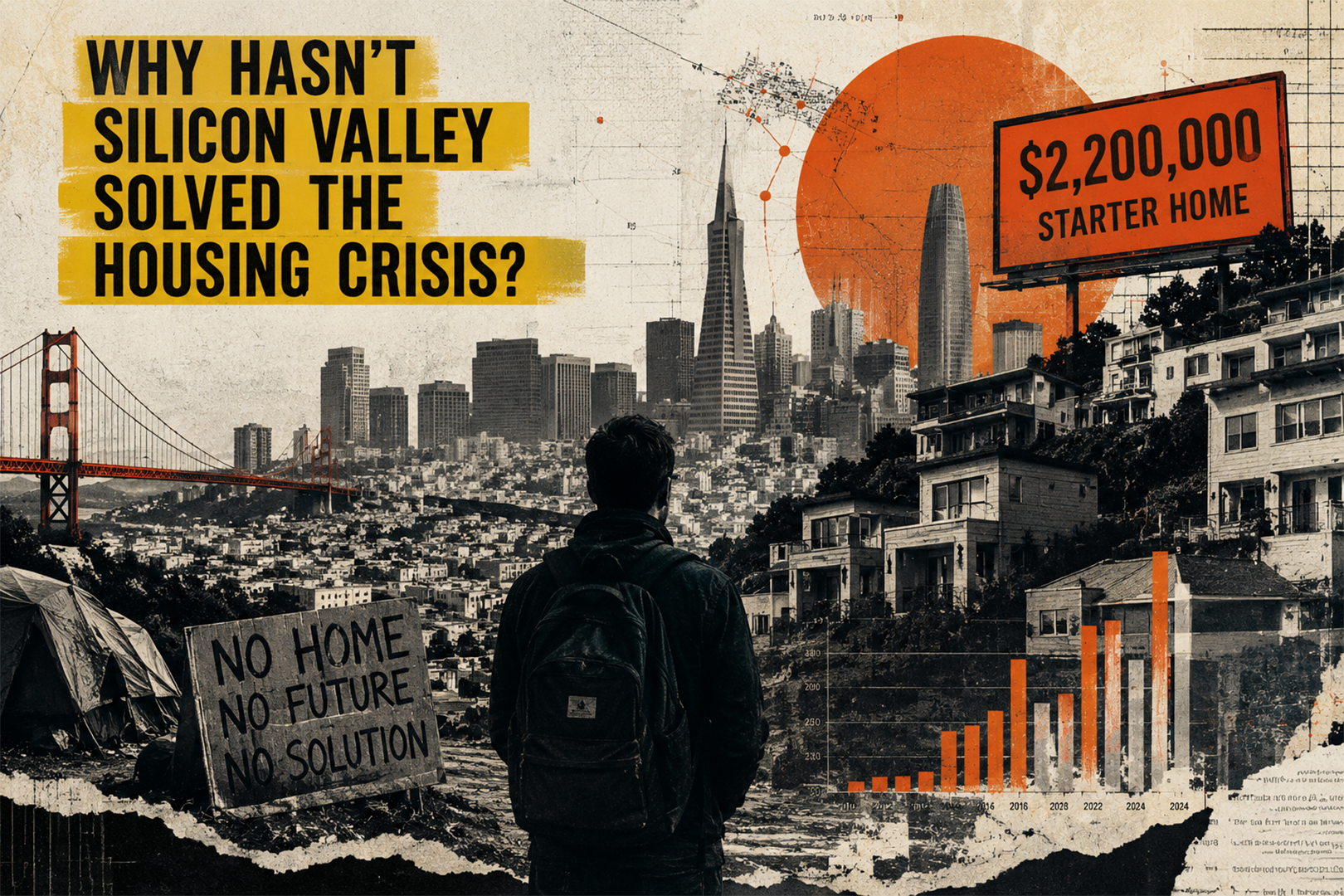
If an outsider were dropped into Silicon Valley with no knowledge of California politics, they might reasonably assume the Bay Area had already solved housing.
After all, this is where humanity taught computers to recognize faces, translate languages in real time, drive automobiles without human intervention, and generate software using artificial intelligence. The region has created companies worth trillions of dollars and attracted some of the brightest engineers, scientists, entrepreneurs, and investors in modern history. Every year, billions of dollars flow into research laboratories and startups focused on solving problems that only a decade ago sounded like science fiction.
Yet drive just a few miles beyond the campuses of Google, Apple, NVIDIA, Meta, or Stanford University, and a very different reality begins to emerge.
Families earning six figures struggle to buy their first home. Teachers, nurses, firefighters, nonprofit leaders, and public servants routinely commute two or three hours each day because living near their jobs has become financially impossible. Young professionals postpone starting families because housing consumes such a large percentage of their income. Tens of thousands of Californians remain unhoused, while others leave the region altogether in search of affordability they can no longer find in the place that helped redefine the global economy.
Few places on Earth better illustrate the contradiction between extraordinary innovation and extraordinary scarcity.
If Silicon Valley can build artificial intelligence capable of writing software, diagnosing diseases, and accelerating scientific discovery, why hasn’t it solved one of the most visible problems in its own backyard?
The Misconception About Tech Companies and Housing
The answer is not that the technology does not exist. Nor is it that Silicon Valley’s largest companies simply do not care.
In fact, one of the biggest misconceptions surrounding the Bay Area’s housing crisis is the idea that technology companies stood on the sidelines while housing costs spiraled out of control. The historical record tells a far more complicated story. Over the past decade, many of the region’s largest employers publicly advocated for additional housing production, invested billions of dollars into affordable housing initiatives, partnered with nonprofit organizations, and urged local governments to accelerate residential development. Their motivations were hardly altruistic. Housing shortages increase labor costs, make recruiting talent more difficult, and threaten the long-term competitiveness of the entire region.
From a purely economic standpoint, abundant housing benefits almost everyone. Employers gain access to a larger workforce. Employees spend less of their income on rent or mortgages. Local businesses benefit from increased consumer spending. Governments collect more revenue through economic growth. Communities become more accessible to teachers, first responders, healthcare workers, and the countless professionals who keep cities functioning.
So why didn’t it happen?
L&R Press Insight
Housing is not primarily a technology problem. It is a coordination problem.
Technology companies can build extraordinary tools, but housing requires local governments, voters, agencies, developers, utilities, financiers, nonprofits, and community stakeholders to move together across years of decisions.
Housing Is Built Through Permission, Not Software
Despite all of Silicon Valley’s technological achievements, housing is not primarily a technology problem. It is a coordination problem.
Every new housing development requires dozens of independent participants to make hundreds of decisions over several years. Local planning departments review proposals. City councils weigh competing priorities. Environmental agencies conduct analyses. Utility providers evaluate infrastructure capacity. Transportation agencies assess traffic impacts. Affordable housing developers assemble financing from multiple public and private sources. Community organizations advocate for neighborhood interests. State agencies impose regulatory requirements. Federal programs establish funding conditions. Voters ultimately influence many of these decisions through elections and public hearings.
Each participant may be acting rationally. Each organization may believe it is advancing the public interest. Yet when viewed collectively, the system often moves at a pace that bears little resemblance to the urgency of the crisis itself.
This is where the conversation around housing often begins to break down.
Public debate tends to reduce the issue to a series of simple narratives. Some argue that developers are not building enough housing. Others blame local governments for excessive regulation. Still others point to environmental review, investor speculation, construction costs, zoning restrictions, or corporate influence. Each explanation contains some truth, but none fully captures why solving the problem has proven so difficult.
No Single Institution Controls the Outcome
The reality is that no single institution controls the outcome. Not developers. Not city governments. Not Sacramento. Not Washington. And not even the technology companies with the largest market capitalizations in the world.
Silicon Valley’s biggest firms possess extraordinary influence over software, consumer electronics, artificial intelligence, and global communications. They do not possess the authority to rewrite local zoning ordinances or compel communities to embrace rapid population growth when many residents remain concerned about traffic, school capacity, neighborhood character, or declining quality of life. In a democracy, those decisions ultimately belong to voters and the elected officials who represent them.
Ironically, the same companies often blamed for driving housing costs upward have spent years arguing for exactly the opposite outcome. If housing were abundant, employers would not need to offer compensation packages large enough to offset the region’s extraordinary cost of living. The current system forces companies to compete for a limited supply of housing rather than helping create more of it. Highly compensated workers purchase the best homes available, placing upward pressure on prices across the market and pushing middle-income families farther from the communities where they work.
The result is a cycle that feeds itself. Housing scarcity drives higher wages. Higher wages increase purchasing power among a relatively small segment of the population. Limited supply allows prices to continue climbing. Rising prices push moderate-income residents farther away, increasing commute times, transportation costs, and economic inequality across the region.
The more successful Silicon Valley becomes, the more expensive it becomes to participate in that success.
The Missing Layer: Coordinated Execution
For years, policymakers have debated whether the answer lies in changing zoning laws, streamlining environmental review, increasing public subsidies, or encouraging higher-density development. Those conversations remain important. But they may also overlook something equally significant.
What if the greatest obstacle is not simply policy? What if it is the inability of hundreds of organizations to coordinate around a shared mission?
That question sits at the center of how L&R Press thinks about housing, artificial intelligence, and the future of public problem-solving. The Bay Area does not suffer from a lack of intelligence, ambition, capital, or technical capability. It suffers from fragmented execution across systems that were never designed to move at the speed of the crisis.
A housing project can stall because one approval is delayed, one agency is waiting on another, one funding source is unclear, one community concern is unresolved, or one responsible party does not know the next step. Multiply that across hundreds of projects, dozens of jurisdictions, and years of policy debate, and the scale of the coordination challenge becomes visible.
The Mission Ladder Question
What would happen if every housing initiative had a visible roadmap, assigned ownership, deadlines, funding pathways, and real-time accountability?
That is the operational layer L&R Press believes technology can help build. Not technology replacing government, communities, or developers, but technology helping them coordinate around measurable outcomes.
How Technology Can Help Without Replacing People
Artificial intelligence is often discussed as if it will either solve everything or destroy everything. Housing requires a more practical conversation. AI will not eliminate zoning disputes, remove public opposition, or build trust between communities and developers. But it can help organize information, surface bottlenecks, summarize public feedback, track deadlines, identify underutilized land, forecast administrative delays, compare funding opportunities, and help leaders understand where projects are actually getting stuck.
The goal is not to remove humans from decisions that affect neighborhoods. The goal is to give humans better visibility, better coordination, and better tools for turning decisions into outcomes. In housing, the difference between a good idea and a completed project is often not brilliance. It is follow-through.
At L&R Press, that is why we continue building around the Mission Ladder. A Mission Ladder turns a broad goal into an organized sequence of actions. It identifies the next step, the owner of that step, the timeline, the risk, and the larger outcome the step supports. Applied to housing, the concept becomes even more powerful because housing projects require so many people to remain aligned over long periods of time.
The Bay Area’s Next Innovation May Not Be Another App
Silicon Valley may have built the tools that changed the world, but the Bay Area’s next great innovation may need to be less glamorous and more practical: a better way to coordinate people, agencies, funding, policy, land, infrastructure, and public will around the shared mission of making housing more attainable.
The housing crisis will not be solved by technology alone. It will not be solved by private companies alone. It will not be solved by government alone. It will require a new kind of operating system for civic execution, one that helps communities move from discussion to implementation and from implementation to measurable results.
If the Bay Area wants to remain the world’s innovation capital, it cannot only build technology for everyone else. It has to learn how to use technology, governance, and human coordination to solve the problems that define life at home.
That is where L&R Press believes the next chapter begins.
About L&R Press
L&R Press builds operational intelligence systems, client portals, Mission Ladder frameworks, and execution infrastructure for organizations working across housing, workforce development, public systems, philanthropy, reentry, and community impact.
Our philosophy is simple: Human Care. Powered by AI.
What’s Next
The future of housing requires better coordination.
L&R Press helps organizations turn complex public problems into structured missions with clear ownership, measurable progress, and execution systems built for real-world outcomes.
Explore the Client Portal