Artificial Intelligence & Operational Strategy
Why Apple Believes the Future of Data Is Right in Front of Your Eyes
Smart glasses are turning artificial intelligence into a live lens on the physical world. L&R Press believes organizations need the same kind of vision.
L&R Press Editorial · 10 min read · Updated July 2026
Technology Is Learning to See the World Around Us
For most of the digital era, technology asked us to look away from the world.
We looked down at phones, across at laptops, and up at conference-room screens. The information was powerful, but it lived somewhere else. To use it, we had to stop what we were doing, open an application, find the right dashboard, and interpret what had already happened.
Smart glasses are beginning to reverse that relationship. They represent the rise of ubiquitous technology, a world in which computing is no longer confined to a device we deliberately open, but is embedded into the environments, objects, and experiences surrounding us. These glasses can continuously interpret what the wearer sees, hears, and encounters, then exchange that information with AI systems in real time.
This constant flow of live data points toward the future of technology itself. Devices, software, businesses, and physical environments will increasingly communicate with one another instantly, allowing systems to recognize changing conditions, surface relevant information, and recommend action before a person has to stop and search for it.
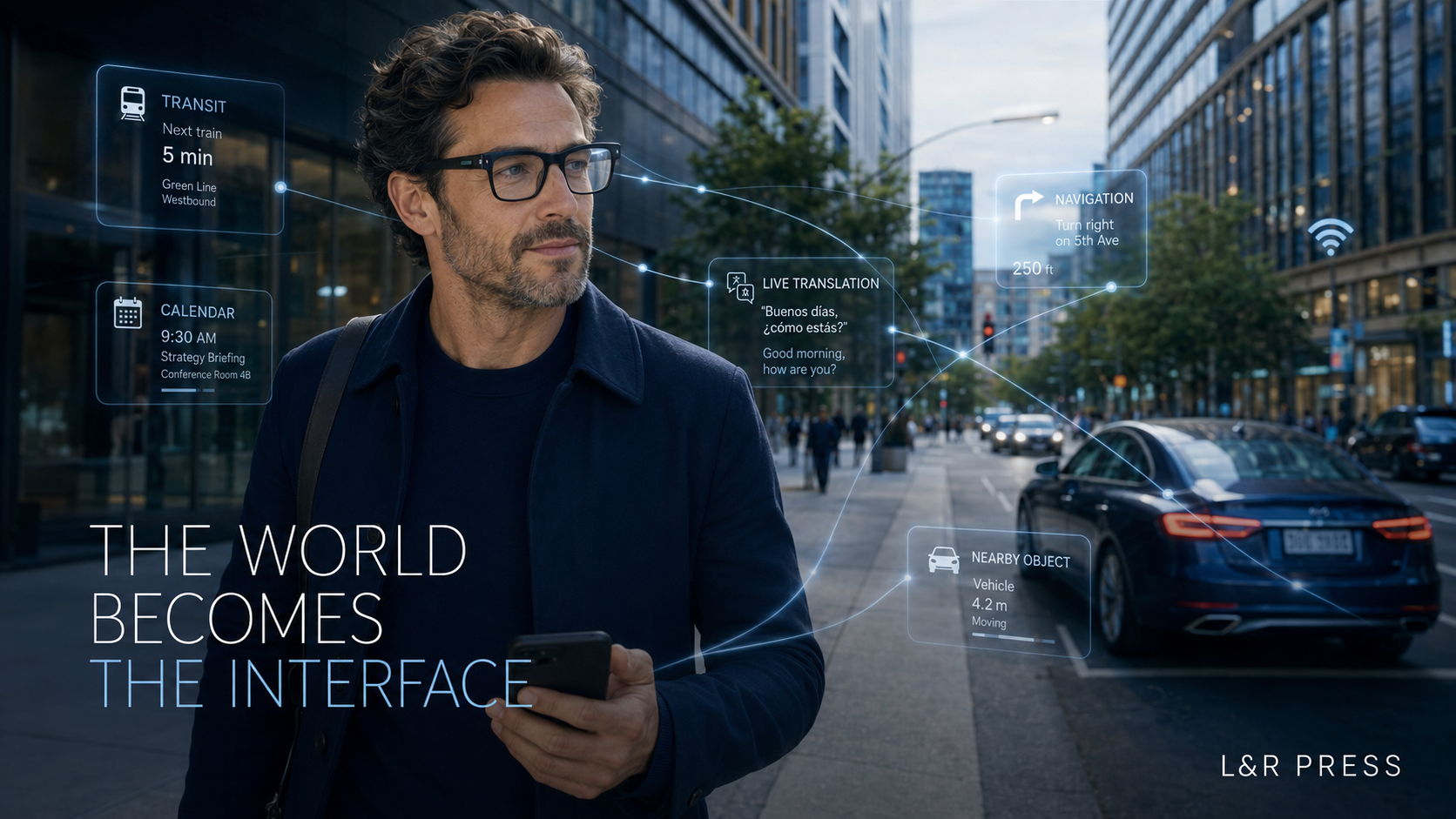
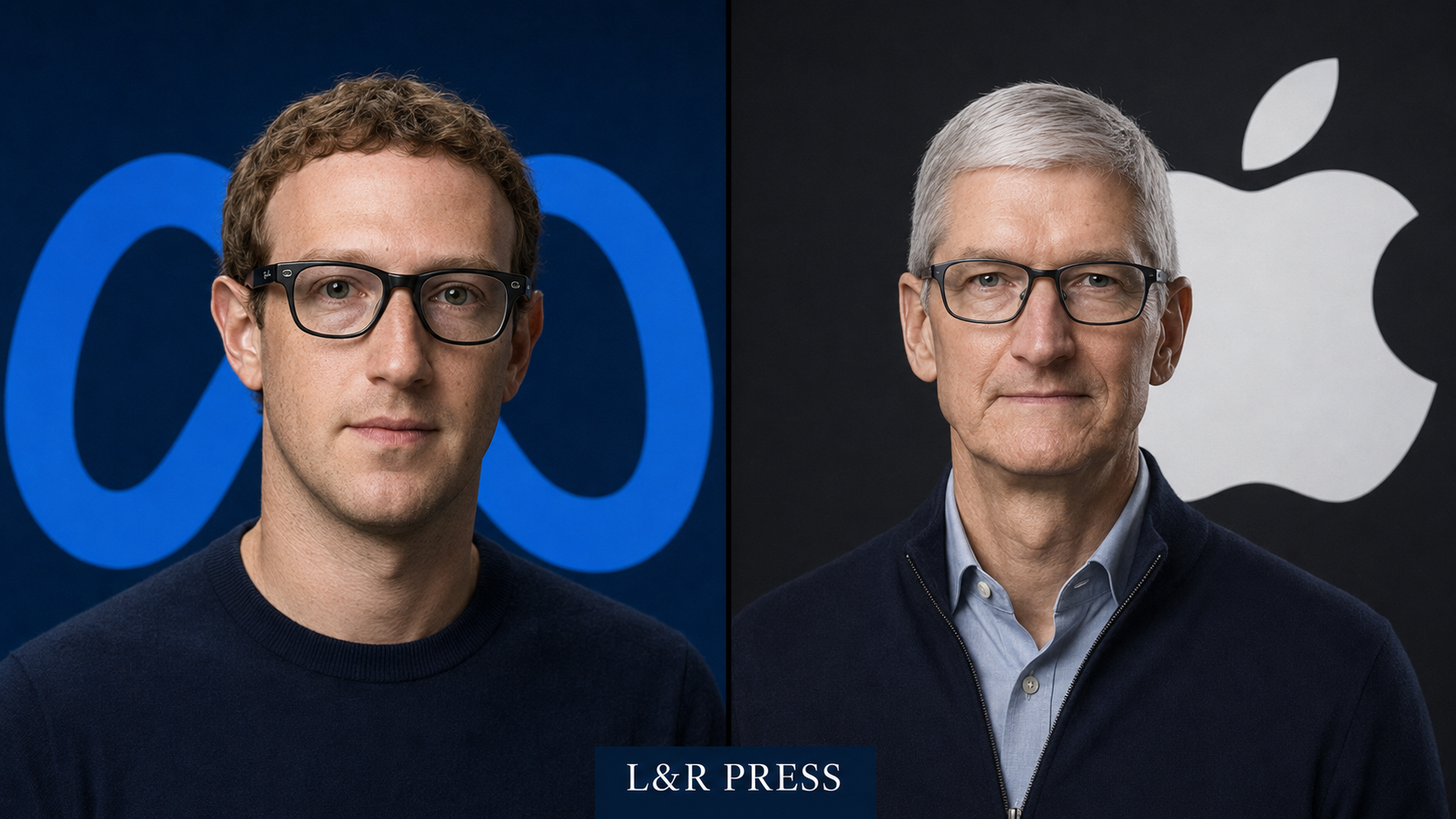
Meta’s AI glasses use cameras, microphones, speakers, and artificial intelligence to respond to what a person is seeing and hearing. The technology can recognize objects, answer questions about the surrounding environment, translate conversations, capture moments, and deliver information without forcing the user to retreat into a separate digital world.
Now Apple Reportedly Wants In
Reuters has reported that Apple shifted resources away from a planned Vision Pro overhaul to accelerate work on AI-powered glasses designed to compete with Meta’s Ray-Ban line. More recent reporting points to a possible 2027 release. Apple has not officially announced smart glasses or publicly explained why it is developing them.
Apple’s own public statements make the strategic logic easier to understand. The company does not see glasses as merely another wearable accessory. It sees spatial computing as the next major interface between people, information, and their physical surroundings. When Apple introduced Vision Pro, CEO Tim Cook declared, “Today marks the beginning of a new era for computing,” comparing spatial computing’s potential significance to the arrival of the Mac and iPhone.
Apple has been building toward this model for years. As far back as the Apple Watch launch, Cook said the company wanted people to “easily access information that matters” and “interact with the world.” Smart glasses take that philosophy further by placing cameras, microphones, sensors, AI, and voice assistance at eye level, where technology can receive and interpret real-world information as events unfold.
Artificial intelligence makes that interface considerably more valuable. Apple says its approach combines generative AI with “a user’s personal context to deliver truly helpful intelligence.” Glasses could give that intelligence something it currently lacks: a continuous understanding of the user’s immediate surroundings. The system would not only know what is stored on the user’s devices. It could understand what the user is seeing, hearing, doing, and potentially trying to accomplish.
That explains why Apple cannot afford to leave the category to Meta. If smart glasses become the next major computing platform, the company that controls the glasses could control the interface through which consumers access AI, communications, navigation, commerce, entertainment, health information, and everyday decision support. Apple built one of the world’s most valuable technology ecosystems by owning the relationship between its hardware, software, services, and users. Smart glasses could become the next layer of that relationship.
The real race is not about who can put a camera inside the best-looking frame. It is about who can build the most useful layer of intelligence between a person and the physical world.
The Screen Is Leaving the Desk
With technology companies focusing on systems that blend digital content with physical space, smart glasses push that idea into a more familiar form. Instead of placing a computer on your desk, the device travels through the world with you and helps interpret what is happening as it happens.
That change sounds subtle. It is not.
The defining feature of the next generation of computing may be context.
Traditional software waits for a command. Contextual AI can observe the situation, connect what it sees to relevant information, and help a person decide what to do next.
Imagine walking through an unfamiliar city and hearing a live translation. Imagine looking at ingredients and receiving a recipe suggestion. Imagine a technician seeing service instructions while standing beside the equipment. Imagine a physician reviewing critical information without turning away from the patient.
The device becomes valuable because it reduces the distance between a signal and a decision.
That is why Apple’s reported arrival in AI wearables matters. Apple has repeatedly transformed emerging technologies by making them feel intuitive, desirable, and ordinary. The company did not invent the personal computer, digital music player, smartphone, smartwatch, or mixed-reality headset. Its advantage has often been turning complicated technology into an experience that millions of people can understand.
If Apple succeeds with smart glasses, AI wearables could move from an interesting accessory to a new computing habit.
The larger implication reaches far beyond consumer electronics. Once people become accustomed to technology that interprets their surroundings in real time, they will become less tolerant of institutions that operate with delayed, fragmented, and incomplete information.
If my glasses can understand what is happening around me, why can’t my organization understand what is happening inside it?
Most Organizations Are Still Operating Without Their Smart Glasses On
Businesses, nonprofits, public agencies, and growing institutions generate operational signals all day.
A priority changes during a leadership call. A deadline is mentioned in a meeting. A client raises a concern by email. A team member agrees to own a task. A funding opportunity creates a new requirement. A project begins to drift. A risk appears quietly in a conversation long before it reaches a formal report.
The signals exist. The problem is that leaders cannot see them together.
They are scattered across meeting transcripts, inboxes, spreadsheets, project-management tools, text messages, and people’s memories. By the time the information is assembled into a report, the moment to act may have passed.
This is an operational visibility problem. It is also the problem L&R Press is solving through Real-Time Mission Management™.
L&R Press Insight
Real-Time Mission Management™ is like putting Meta glasses on your business.
Suddenly, the invisible becomes visible.
Leaders can see what matters, what is slipping, who owns what, where momentum is building, where risk is emerging, and what requires attention next.
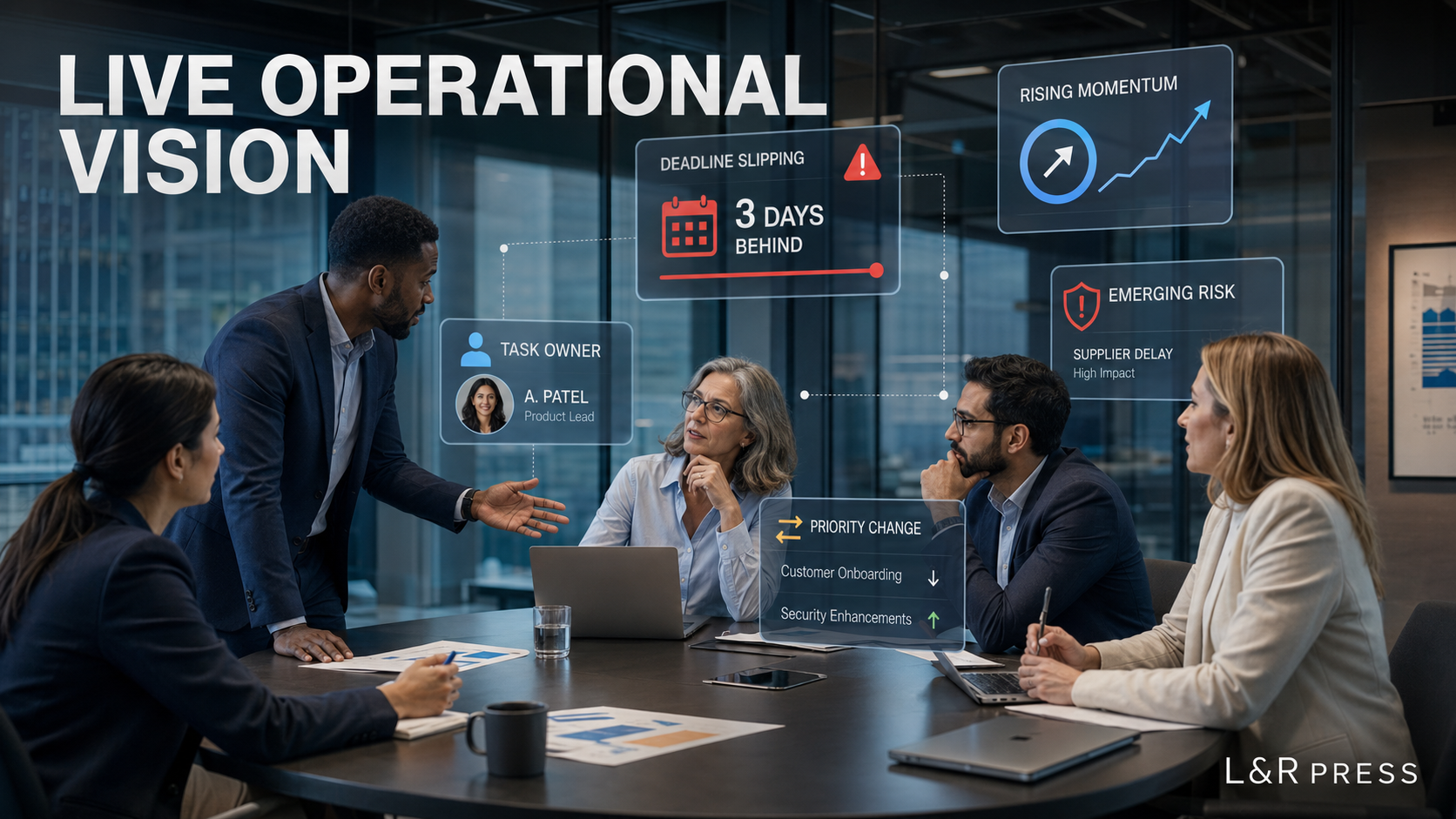
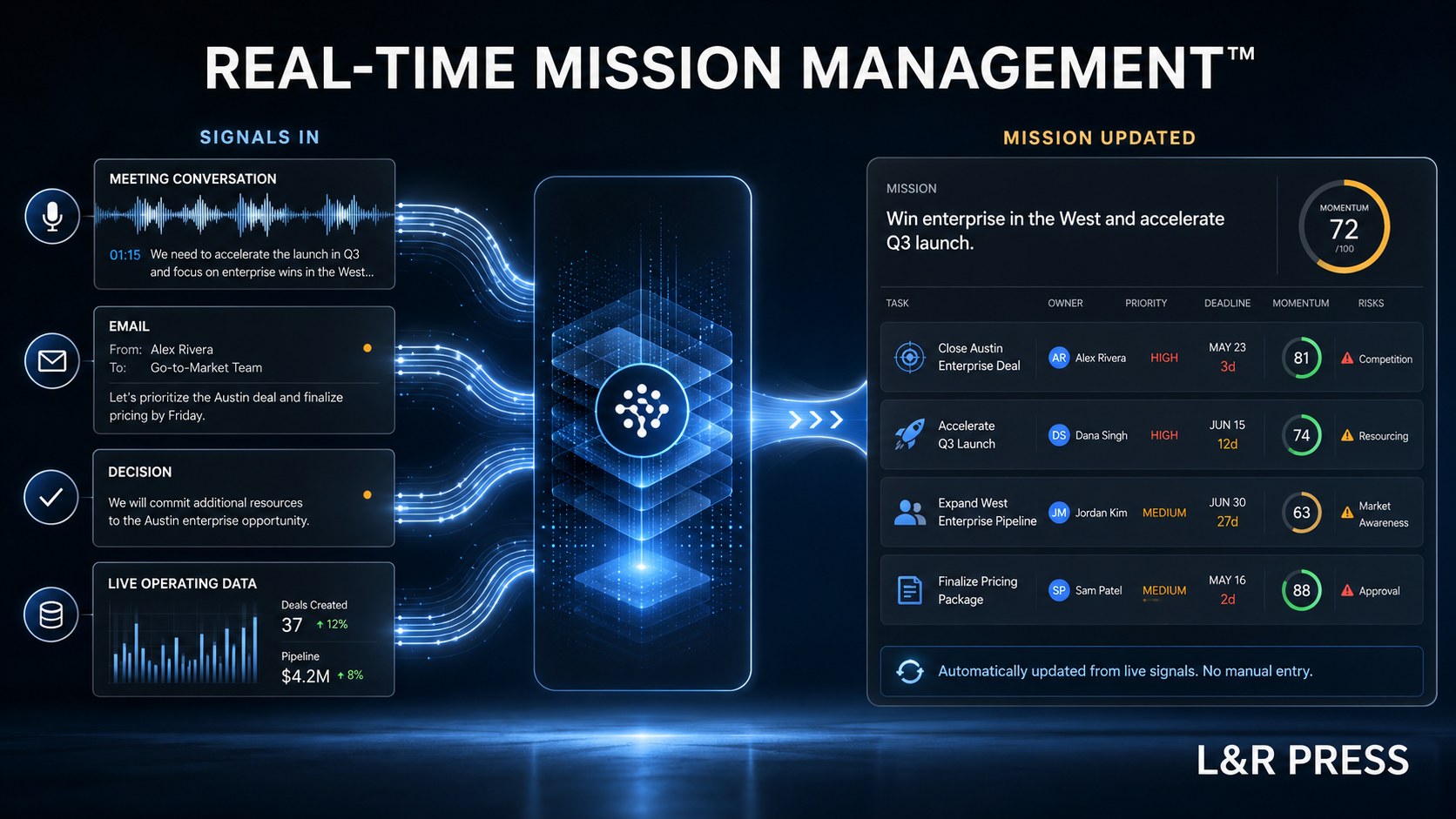
As meetings, decisions, communications, and operating data are exchanged, the system automatically updates the tasks required to achieve the organization’s stated goals. No one has to manually enter updates, reorganize priorities, or tell the system what changed. The business can continue operating as usual while its mission, priorities, ownership, risks, and next actions continuously adjust to real-time information.
This is not another static dashboard. It is not a chatbot attached to an old workflow. It is an intelligent operating system that sees the organization as it moves and keeps its execution plan aligned with reality.
It is a new way of seeing and running an organization.
L&R Press Is Building the Operational Vision Layer
L&R Press is a consulting firm that has always leveraged technology to help clients solve complex problems and make better decisions. Our work has included raising capital for nonprofits, advancing public-policy initiatives, analyzing workforce transitions and wrongful terminations, evaluating leadership transitions within city government, and examining the organizational and legal implications of legislation such as the CROWN Act.
Today, L&R Press builds on that experience by helping organizations move beyond isolated AI experiments and implement AI-powered execution systems around the work they already do.
We have found that our clients cannot afford to stop operating while a complicated new software platform is installed. So we created an onboarding process where teams can continue holding meetings, making decisions, serving clients, and advancing projects while leveraging technology to achieve their stated goals. Real-Time Mission Management uses the conversations and information the organization is already generating to create a clearer, continuously updated operating picture.
Our AI business consulting work focuses on the gap between strategy and execution.
Many organizations already have a mission. They already have talented people. They may even have strong plans, valuable partnerships, and access to funding. What they lack is a reliable system that converts daily activity into shared awareness and coordinated action.
Real-Time Mission Management closes that gap by helping leaders:
- Convert meetings into accountable next steps
- Keep priorities synchronized as conditions change
- Identify stalled work before it becomes a missed deadline
- Clarify ownership across teams and partners
- Surface operational risks earlier
- Preserve institutional knowledge after conversations end
- Connect strategy, execution, compliance, and outcomes
- Give decision-makers a live view of organizational momentum
This is where AI business consulting becomes materially useful.
The goal is not to add artificial intelligence because it is fashionable. The goal is to create measurable operational intelligence. L&R Press works with leadership teams to structure the management system, define the signals that matter, build the visibility layer, and establish the routines needed to act on what the system reveals.
See Your Mission Live
The smart-glasses revolution is teaching the public a powerful lesson: better technology does not merely give us more data. It changes what we are able to notice.
That is the opportunity for business leaders.
Your organization is generating signals all day. Most leaders never see them clearly enough or fast enough.
Real-Time Mission Management turns meetings, decisions, and live operating data into a continuously updated view of what your mission needs now.
Like Meta glasses for your business, it helps you see what is moving, what is stuck, and what needs action before momentum is lost.
The first step should not feel like filling out an application for another generic consulting call. It should feel like a revelation.
Real-Time Mission Management™
Activate Live Mission Visibility
See your mission live. Discover what your organization has been trying to tell you. L&R Press helps leaders implement Real-Time Mission Management through AI business consulting, operational strategy, execution-system design, and live mission visibility.
The organizations that lead the next decade will not simply have more artificial intelligence.
They will see sooner.