Executive Editorial
Every Foster Child Deserves Mission-Driven Help, Not Just A Case File
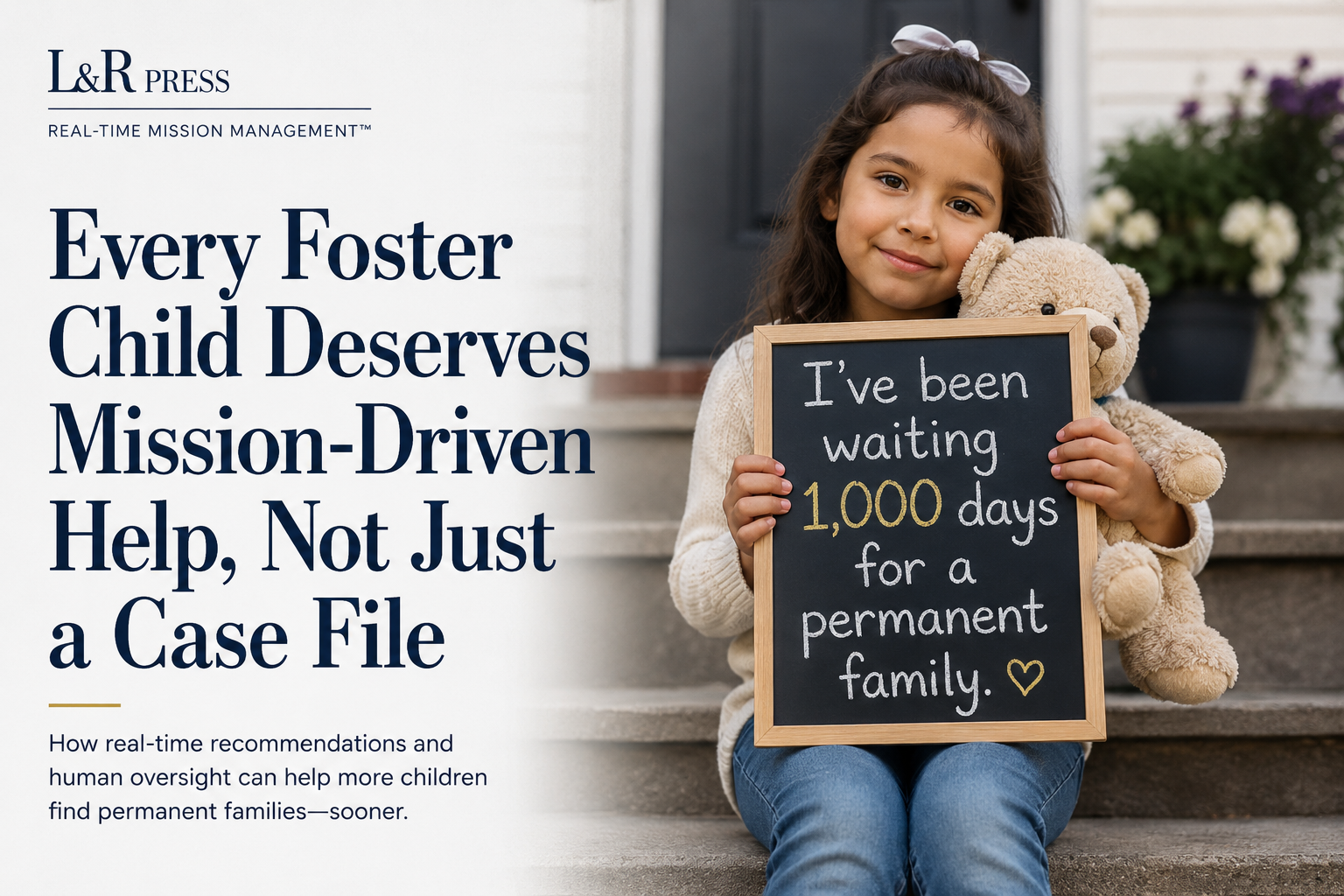
Every Child’s Mission
Every child entering the foster care system begins a journey that is intended to end in the same place: a safe, stable, and permanent family. That destination may be reunification with parents after services and support have addressed the conditions that led to removal. It may be placement with relatives willing to provide long-term care. It may ultimately become adoption. While every child's circumstances are unique, the objective remains remarkably consistent across California's child welfare system. Children should not remain in temporary care longer than necessary, and every decision made on their behalf should move them one step closer to permanence. [California Department of Social Services; California Courts]
Few people would disagree with that principle. The challenge has never been defining the mission. The challenge has always been executing it.
California's foster care system is supported by an extraordinary network of professionals and organizations. County child welfare agencies, nonprofit foster family agencies, courts, schools, behavioral health providers, medical professionals, CASA volunteers, attorneys, foster parents, biological families, and community organizations all contribute essential expertise. Each plays a distinct role in helping children heal, maintain stability, and ultimately find permanent homes. The overwhelming majority of these professionals entered the field because they care deeply about children and families. Yet despite their commitment, many children continue waiting months, and sometimes years, for outcomes that everyone involved hopes to achieve as quickly as possible. [California Department of Social Services]
Every significant step in a child's journey depends upon information moving successfully between people and organizations. A therapist may observe meaningful emotional progress that supports expanded family visitation. A teacher may recognize dramatic improvements in attendance and classroom engagement. A foster parent may notice that anxiety surrounding parental visits has steadily decreased. A biological parent may successfully complete additional services required by the court. A physician may identify medical needs that have finally stabilized. Each observation, viewed independently, appears to represent a single update within a much larger case. Collectively, however, those observations may indicate that a child is substantially closer to reunification than anyone fully realizes.
What is the next best action that safely moves this child closer to a permanent family?
The difficulty is that no single professional necessarily possesses the complete picture. Each participant sees the portion of the child's journey that intersects with their own responsibilities. Therapists understand therapeutic progress. Schools understand educational outcomes. Foster parents understand daily behavior within the home. Social workers coordinate multiple services while balancing numerous cases. Attorneys prepare for court hearings. Judges evaluate evidence presented during scheduled proceedings. Every participant contributes an important perspective, yet those perspectives often remain distributed across meetings, reports, case notes, emails, assessments, and conversations occurring over weeks or months.
This fragmentation creates one of the least visible challenges in child welfare. Important opportunities are rarely missed because someone failed to care. They are missed because no mechanism exists to continuously assemble dozens of independent observations into one coherent picture capable of revealing that the child may be ready for the next step. Recommendations become trapped inside meeting notes. Patterns remain hidden because they emerge gradually across multiple organizations rather than appearing within a single report. Decisions that could safely accelerate reunification or adoption frequently wait until the next scheduled review because no system continuously recognizes that the conditions supporting those decisions have already begun to emerge.
Children should never wait because critical recommendations are trapped inside meeting notes, disconnected systems, or organizational bottlenecks.
The consequences of those delays extend far beyond administrative inconvenience. Every additional month spent in temporary care can mean another school transition, another adjustment to new caregivers, another period of uncertainty, and another delay in building the permanent relationships every child deserves. For professionals working within the system, these delays are equally frustrating because they often recognize that progress is occurring while lacking efficient mechanisms for translating that progress into coordinated action. Everyone continues working toward the same mission, yet the pace at which information moves frequently determines the pace at which children move toward permanency. [Casey Family Programs; KidsData]
Historically, child welfare has responded to this complexity by strengthening documentation, expanding reporting requirements, introducing additional assessments, and improving communication between participating organizations. These efforts have produced meaningful improvements and remain essential components of responsible practice. At the same time, they reflect an operating model largely designed around documenting what has already happened rather than continuously recognizing what is happening now. Modern technology, particularly advances in artificial intelligence, creates an opportunity to reconsider whether coordination itself can evolve. The central question is no longer whether organizations can collect sufficient information. The question is whether they can recognize important opportunities quickly enough to act while those opportunities still exist.
This distinction represents more than a technological challenge. It represents a different philosophy of child welfare. Rather than viewing each meeting, assessment, or provider update as an isolated administrative event, organizations may begin viewing every approved conversation as another opportunity to move a child closer to permanency. The objective shifts from managing individual case activities to continuously advancing a clearly defined mission. Every recommendation, every service, every review, and every decision becomes meaningful only insofar as it helps answer one fundamental question:
What is the next best action that safely moves this child closer to a permanent family?
Foster Care Has Become A Coordination Challenge
Public discussion surrounding foster care often focuses on individual components of the system. Conversations frequently center on the availability of foster families, reimbursement rates, behavioral health services, educational outcomes, or the length of time children remain in care before achieving permanency. Each of these issues deserves serious attention. Each influences the experiences of children and families in meaningful ways. Yet focusing on any single component can unintentionally obscure a larger operational reality.
Modern child welfare is no longer defined by the work of a single agency. It is defined by the interaction of many agencies attempting to accomplish one mission together. [California Department of Social Services]

This distinction becomes particularly important because the information generated by these organizations rarely exists within a single operational environment. Educational records remain within school systems. Clinical observations remain within behavioral health providers. Court findings exist within judicial records. Nonprofit agencies maintain their own documentation, while counties manage separate case management systems subject to distinct legal and operational requirements. Every organization documents important developments according to its own responsibilities, yet the child's experience extends across all of them simultaneously.
The consequence is not necessarily the absence of information. Quite the opposite. Child welfare professionals often work within environments where the volume of available information is extraordinary. The difficulty lies in recognizing when separate observations, made by different professionals at different times, collectively suggest that an important opportunity has emerged.
Recognizing that pattern, however, requires more than documentation. It requires synthesis.
The distinction between documentation and synthesis represents one of the most significant operational challenges facing complex human service systems today. Documentation records what individual professionals observe. Synthesis identifies what those observations may mean when considered together. Documentation answers the question, "What happened?" Synthesis asks a different question entirely.
Historically, answering that second question has depended almost entirely upon periodic meetings, formal reviews, and the remarkable institutional knowledge carried by experienced professionals. Those mechanisms remain indispensable. They also require significant time. As information continues accumulating between meetings, opportunities capable of benefiting children may remain unrecognized simply because no process exists to continuously evaluate how newly emerging information changes the larger picture. [California Department of Social Services]
From an operational perspective, foster care resembles one of the most complex collaborative environments found anywhere in public service. Yet many of the systems supporting that collaboration remain organized around static documentation rather than continuously evolving operational awareness.
This observation should not be interpreted as criticism of the professionals working within child welfare. On the contrary, it highlights the extraordinary demands placed upon them. The social worker responsible for coordinating multiple cases cannot reasonably be expected to manually recognize every emerging relationship hidden within thousands of pages of documentation, meeting notes, assessments, provider reports, educational records, and caregiver observations. Likewise, nonprofit organizations supporting foster families often possess valuable operational knowledge that deserves broader consideration without requiring additional administrative burden for already overextended staff.
The challenge, therefore, is not asking people to work harder. It is helping the system learn faster.
This distinction fundamentally changes how technology should be introduced into child welfare. Much of today's discussion surrounding artificial intelligence focuses on automation. Can AI summarize documents? Can it organize records? Can it complete forms? Can it reduce administrative workload? These capabilities undoubtedly provide value. They also address only a portion of the larger opportunity.
The greater opportunity lies in helping organizations recognize meaningful patterns while there is still time to improve outcomes for children.
Rather than replacing professional judgment, technology can expand professional awareness. Rather than automating decisions, it can prepare evidence based recommendations for human review. Rather than asking every organization to continuously search for important connections across thousands of independent observations, technology can assist in identifying where those connections may already exist.
The question is no longer whether child welfare professionals possess sufficient information to improve outcomes. Increasingly, the question is whether the system can recognize the significance of that information before another child spends unnecessary time waiting for a permanent family.
From Case Management To Mission Management™
If the central challenge facing modern child welfare is coordination rather than commitment, then an equally important question follows naturally.
How should organizations coordinate differently?
For decades, child welfare has understandably been organized around the concept of case management. Every child has a case. Every case contains assessments, reports, court documents, service plans, provider updates, educational records, visitation schedules, and countless other pieces of information that collectively describe the child's circumstances. Case management has provided an essential organizational structure for documenting those circumstances, preserving accountability, and ensuring that statutory responsibilities are fulfilled. It remains one of the foundations upon which modern child welfare operates. [California Courts]
Yet documentation and coordination are not the same activity.

A case file can accurately describe everything that has happened to a child while offering remarkably little guidance about what should happen next. It records history exceptionally well. It does not necessarily organize the future.
That question differs fundamentally from asking whether documentation is complete or whether required meetings have occurred. It asks whether every available observation, recommendation, and emerging opportunity is being organized around a single mission rather than simply preserved within a case record.
This realization gradually shifted our own thinking.
Rather than asking how technology could help organizations manage case files more efficiently, we began asking whether technology could help organizations continuously organize themselves around the child's mission.
That question eventually became the philosophical foundation of Real-Time Mission Management™.
The distinction is important.
The objective is not automated decision making. The objective is better recommendations.
Real-Time Mission Management™ is not designed to replace case management. Cases remain essential for legal documentation, compliance, judicial review, and historical recordkeeping. Instead, Real-Time Mission Management™ operates as an execution layer that continuously asks a different question.
Given everything we now know, what should happen next?
Artificial intelligence excels at recognizing patterns across large volumes of information. It can compare current discussions with previous meetings, identify recurring themes across provider reports, summarize lengthy documentation, perform deep research, and recognize relationships that individual participants may reasonably overlook while managing demanding caseloads. Those capabilities create extraordinary opportunities, but they should never be confused with professional judgment.
Recognizing a pattern is not the same as deciding what action should be taken.
That responsibility remains fundamentally human.
The future of child welfare is not replacing professional judgment. It is ensuring better recommendations reach professionals sooner.
For this reason, Real-Time Mission Management™ was deliberately designed around a principle that differs from many contemporary discussions surrounding artificial intelligence.
The objective is not automated decision making.
The objective is better recommendations.
During every approved interdisciplinary meeting, case conference, provider discussion, or nonprofit planning session, artificial intelligence analyzes the operational information being shared and begins identifying patterns that may deserve additional attention. Those patterns might suggest that a child is progressing toward reunification more quickly than previously understood. They may indicate that placement instability is emerging before it becomes visible to every participating organization. They may reveal opportunities to coordinate educational support, behavioral health services, family engagement, or permanency planning more effectively than existing processes would normally allow.
Mission Recommendations™ represent evidence informed opportunities identified through continuous analysis of approved operational information. They are designed to answer a single question.
What recommendation has the greatest potential to move this child safely toward a permanent family?
Before any Mission Recommendation™ reaches participating nonprofit organizations or public agency leadership, it is reviewed by the L&R Press implementation team. That review exists for an important reason. Artificial intelligence can recognize relationships within information remarkably quickly, but responsible child welfare requires considerably more than pattern recognition. Recommendations must be evaluated within the broader context of organizational policy, legal requirements, available services, community resources, and professional judgment. L&R Press serves as the bridge between analytical capability and responsible operational implementation, ensuring that recommendations delivered through Real-Time Mission Management™ remain practical, mission focused, and appropriate for human consideration.
Only then do nonprofit leaders, county professionals, and other authorized participants determine whether and how those recommendations should influence the child's Mission Ladder™.
This final step may be the most important distinction of all.
Real-Time Mission Management™ does not attempt to tell professionals what decisions to make.
It attempts to ensure that professionals never miss an opportunity to make the right decision while there is still time to improve a child's future.
A continuously learning system that helps extraordinary professionals recognize opportunities sooner, coordinate action more effectively, and maintain relentless focus on the mission that brought every participant into child welfare in the first place.
Helping more children reach safe, permanent families without unnecessary delay.
When Better Recommendations Reach The Right People Sooner
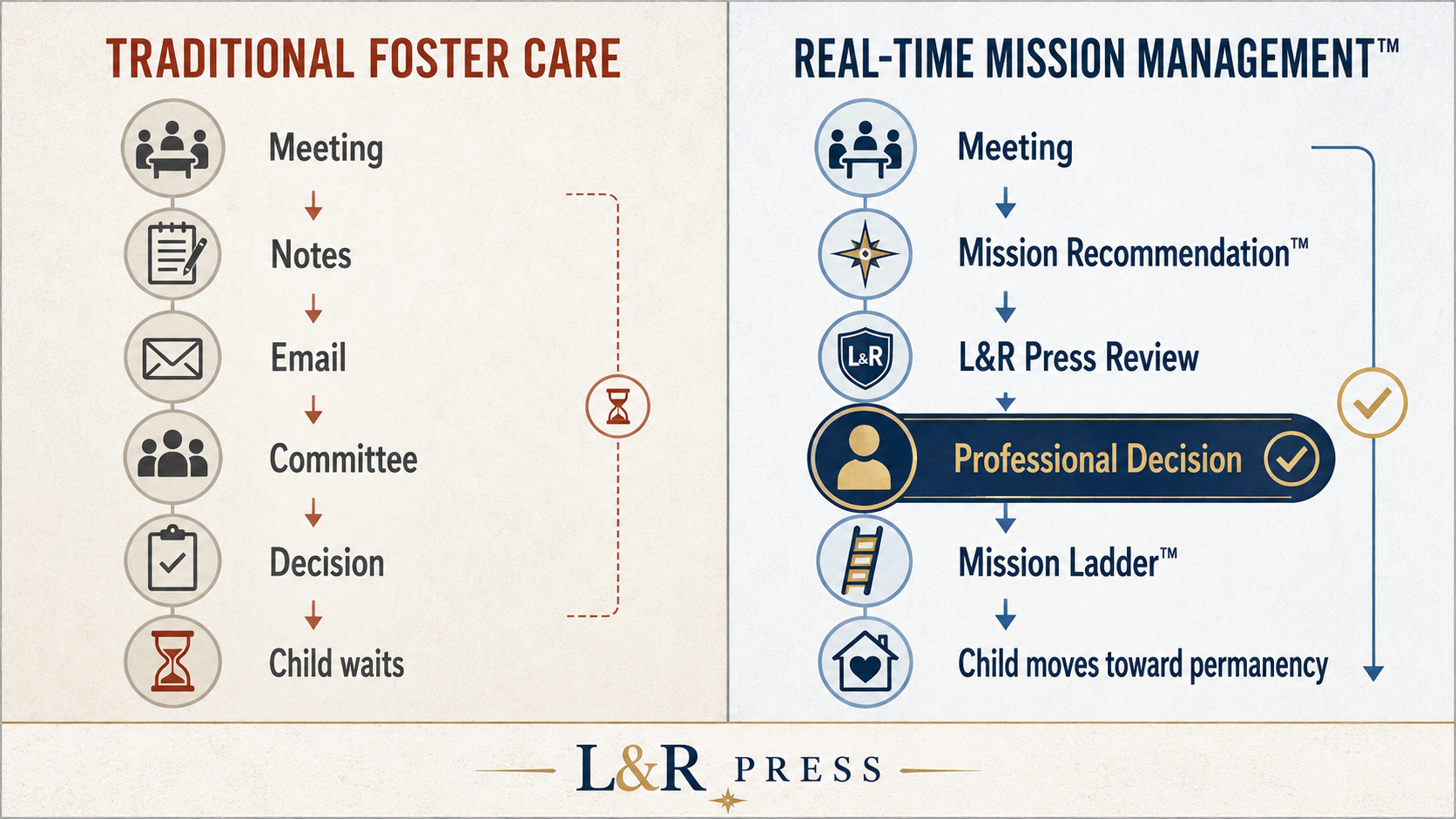
One of the unintended consequences of modern child welfare is that progress rarely announces itself all at once. Children do not suddenly become ready for reunification because of a single therapy session, one successful family visit, or one favorable court report. Permanency is usually the result of dozens of small improvements occurring over time. A biological parent completes another counseling program. School attendance improves. A therapist observes increased emotional regulation. Foster parents describe fewer behavioral challenges. Family visits become more consistent and more positive. Individually, each development appears encouraging but routine. Collectively, they may represent a child moving steadily toward a safe and permanent family.
The difficulty is that these observations rarely arrive in the same place at the same time.
Each professional sees only a portion of the child's progress. The therapist understands emotional development. The school understands educational progress. Foster parents observe daily routines and relationships. Biological parents demonstrate growth through visitation and services. Social workers coordinate these perspectives while balancing numerous other responsibilities. Every participant contributes valuable information, yet the significance of that information often emerges only when the observations are viewed together.
The system is waiting because no mechanism continuously recognizes when independent observations have collectively changed the larger picture.
Consider a child who has remained in foster care for approximately eighteen months. Weekly family visits have gradually become more successful. Teachers report that classroom behavior has stabilized. A therapist notes meaningful emotional progress. The biological parent has maintained employment, completed required services, and demonstrated increasing consistency during supervised visits. None of these updates individually requires immediate action. Each becomes another entry in another report prepared for another meeting.
Under a traditional operating model, these observations remain distributed across multiple organizations until the next formal case review. Professionals continue performing excellent work, yet the larger opportunity remains partially hidden because no single participant possesses every piece of information simultaneously.
Now consider the same circumstances operating inside a Real-Time Mission Management™ environment.
The interdisciplinary meeting concludes much as it always has. Participants discuss recent progress, emerging concerns, educational updates, visitation reports, and therapeutic observations. The difference begins after the meeting ends.
Rather than allowing the discussion to become another set of meeting notes, Real-Time Mission Management™ analyzes the approved operational information and begins identifying relationships that deserve additional attention. Artificial intelligence recognizes that several independent indicators are moving in the same direction. It compares current observations with previous discussions, identifies recurring themes, and performs additional research against the organization's operational history. Instead of generating conclusions, the system prepares a Mission Recommendation™ suggesting that the interdisciplinary team evaluate whether the child may be approaching an appropriate opportunity for expanded visitation or reunification planning.
Before that recommendation reaches participating organizations, it is reviewed by the L&R Press implementation team. This review serves an essential purpose. Artificial intelligence can identify patterns with remarkable speed, but child welfare decisions require context, judgment, and an understanding of operational realities that extend beyond data alone. L&R Press evaluates whether the recommendation is supported by the available information, consistent with agency objectives, and appropriate for professional consideration.
Only then does the recommendation become visible to authorized nonprofit leaders and agency personnel through the Mission Ladder™.
No professional has been replaced.
No legal authority has changed.
No decision has been automated.
The difference is that an opportunity which might otherwise have remained hidden until the next formal review has been recognized while there is still time to act.
The same operating philosophy applies when circumstances begin moving in the opposite direction.
Imagine a foster parent quietly mentioning during a routine provider meeting that a teenager has become increasingly withdrawn over the previous several weeks. A teacher reports declining attendance. A behavioral health provider notes that therapy sessions have become less productive. None of these observations independently suggests an immediate placement disruption. Together, however, they may indicate that additional support should be introduced before the placement reaches a crisis point.
Again, the value does not come from artificial intelligence making decisions.
The value comes from helping professionals recognize that multiple independent observations are beginning to describe the same emerging challenge.
Real-Time Mission Management™ prepares a Mission Recommendation™ identifying the developing pattern. L&R Press reviews the recommendation, confirms that the information supports additional attention, and routes it to the appropriate nonprofit or agency leadership. Additional services, caregiver support, behavioral health resources, or family interventions can then be considered while the placement remains stable rather than after disruption has already occurred.
Perhaps the most important characteristic of this approach is that recommendations are generated continuously rather than periodically. Traditional operating models frequently depend upon scheduled reviews to determine whether circumstances have changed enough to justify action. Mission Recommendations™ operate differently. They acknowledge that children's lives continue changing between meetings. Families continue making progress. Caregivers continue observing important behaviors. Teachers continue recognizing educational improvements. Therapists continue documenting emotional development. Every approved interaction contributes another piece of operational intelligence capable of helping professionals better understand where a child stands today rather than where the child stood during the previous review.
The objective is no longer simply documenting progress.
The objective is ensuring that progress changes what happens next.
When recommendations reach the right professionals sooner, opportunities need not wait for the next meeting.
Children should not have to wait either.
Why Human Judgment Still Matters
Artificial intelligence has become remarkably proficient at recognizing patterns that would be extraordinarily difficult for individual professionals to identify consistently. Modern AI systems can compare thousands of pages of documentation, summarize months of meeting discussions, identify recurring themes across provider reports, recognize similarities between cases, perform extensive research, and organize information with a speed that would have seemed impossible only a few years ago. These capabilities represent one of the most significant technological advances available to organizations working in complex operational environments.
Yet recognizing a pattern and deciding what should happen next remain fundamentally different responsibilities.
This distinction becomes especially important when the lives of children and families are involved.
A recommendation suggesting that reunification planning deserves additional consideration should never become a reunification decision. An observation indicating that placement stability may be deteriorating should never become an automated placement change. A recommendation identifying additional behavioral health support should never replace the clinical judgment of licensed professionals or the legal authority of the courts.
Artificial intelligence should inform decisions.
It should never become the decision maker.
This principle guided the development of Real-Time Mission Management™ from the beginning.
For this reason, Mission Recommendations™ were intentionally designed to include a layer of human validation before reaching participating organizations.
Artificial intelligence performs the continuous analytical work. It reviews approved meeting discussions, identifies recurring patterns, conducts deep research, compares current circumstances with previous operational information, and prepares recommendations based upon the evidence available at that moment. Those recommendations do not automatically enter a child's permanency plan. They do not automatically alter services. They do not automatically modify visitation schedules or influence court proceedings.
Technology becomes a source of operational awareness rather than operational authority.
Instead, they arrive at L&R Press.
Our responsibility begins where artificial intelligence reaches its limits.
Every Mission Recommendation™ undergoes human review before it reaches nonprofit leadership or participating public agencies. Experienced professionals evaluate whether the recommendation accurately reflects the operational information available, whether additional context should be considered, whether legal or organizational requirements influence the recommendation, and whether the proposed course of action aligns with the mission established by the participating organizations. Recommendations may be strengthened, refined, delayed for additional information, or rejected entirely when human judgment determines that the available evidence does not support further action.
This review process is not intended to slow decision making.
It exists to strengthen confidence in the recommendations being delivered.
This combination of artificial intelligence and human oversight creates something neither could accomplish independently.
Artificial intelligence contributes extraordinary analytical capacity. It never becomes distracted, never forgets previous discussions, and never tires of comparing thousands of observations across multiple sources of information. Human professionals contribute judgment, ethics, experience, contextual understanding, and an appreciation for circumstances that rarely appear inside documentation alone. Together, they create a decision support environment that expands professional capability without diminishing professional responsibility.
The distinction may seem subtle, yet it fundamentally changes the relationship between technology and public service.
Instead of asking professionals to trust artificial intelligence, Real-Time Mission Management™ asks artificial intelligence to support professionals.
Instead of replacing experienced nonprofit leaders, county agencies, therapists, foster parents, attorneys, and social workers, the system exists to help them recognize opportunities that might otherwise remain hidden until another meeting or another review.
Technology becomes a source of operational awareness rather than operational authority.
This philosophy extends beyond individual recommendations. It reflects a broader belief about how technology should serve organizations responsible for society's most vulnerable populations. Artificial intelligence should reduce unnecessary administrative burden. It should accelerate research that would otherwise consume valuable staff time. It should recognize patterns that deserve additional attention. Most importantly, it should create additional time for the conversations, relationships, and professional judgment that technology can never replace.
Ultimately, the success of Real-Time Mission Management™ will not be measured by the sophistication of its algorithms.
It will be measured by something much simpler.
Whether nonprofit professionals and public agencies are able to recognize opportunities sooner, coordinate action more effectively, and help more children safely reach permanent families without unnecessary delay.
That has always been the mission.
Technology simply gives dedicated professionals a stronger way to pursue it.
A New Model For Northern California
Every significant improvement in public service begins with a simple question.
What if we stopped accepting unnecessary delays as inevitable?
For decades, organizations serving foster children have continued improving individual components of the child welfare system. New therapeutic models have emerged. Foster parent training has expanded. Courts have refined permanency planning. Schools have strengthened educational protections for children experiencing placement changes. Nonprofit organizations have developed increasingly sophisticated family support programs. County agencies continue adapting to new legislation, funding structures, and best practices. Each improvement represents meaningful progress.
Yet one challenge has remained remarkably consistent.
Information still moves more slowly than children need it to.

Every week, meetings occur throughout Northern California involving foster youth, caregivers, nonprofit providers, county agencies, schools, behavioral health professionals, attorneys, and community organizations. Those meetings produce an extraordinary amount of operational intelligence. Progress is documented. Concerns are raised. New opportunities emerge. Barriers are identified. Recommendations are offered. Action items are assigned.
Then the meeting ends.
The information begins another journey.
The child, however, continues waiting.
The question confronting Northern California is whether they must continue operating this way.
Suppose every approved interdisciplinary meeting became more than a discussion.
Suppose it became an opportunity for the system itself to learn.
A therapist's observation regarding emotional regulation would no longer remain isolated within behavioral health documentation.
Not because professionals were entering more information.
Because the information already existed.
The system simply learned to connect it.
This represents a fundamentally different operating philosophy.
Instead of organizations continuously searching for information, information continuously searches for meaningful relationships.
The difference may appear technical.
Its implications are profoundly human.
The same operational model extends beyond individual children.
Imagine nonprofit organizations throughout Northern California participating within a continuously learning ecosystem.
One organization identifies an innovative caregiver support strategy that reduces placement disruptions.
Another develops a successful approach for increasing biological parent engagement before reunification.
A third discovers methods that improve educational stability following placement changes.
Historically, these innovations spread slowly through conferences, informal relationships, or occasional statewide initiatives.
Real-Time Mission Management™ creates an opportunity for those operational lessons to become organizational intelligence much more quickly.
Patterns observed in one participating organization can generate Mission Recommendations™ benefiting others facing similar challenges.
Successful practices become visible sooner.
Barriers become visible sooner.
Opportunities become visible sooner.
The result is not simply a collection of better informed organizations.
It is a continuously learning regional network focused upon one shared mission.
Helping children safely reach permanent families sooner.
Perhaps the most significant implication of this model extends beyond Northern California itself.
If nonprofit organizations, county agencies, educators, healthcare providers, behavioral health professionals, and community organizations can demonstrate that continuously coordinated recommendations improve outcomes for foster children, the operating philosophy becomes transferable.
Any mission requiring multiple organizations to coordinate around vulnerable populations.
The technology itself is not the innovation.
The innovation is recognizing that organizations become dramatically more effective when recommendations move as quickly as the people they are intended to help.
This is the opportunity now emerging before Northern California.
Not merely to introduce another technology platform.
But to demonstrate a new model for mission driven collaboration.
One in which every participating organization continues performing the work it already does exceptionally well while gaining access to continuously updated operational recommendations designed to reduce unnecessary delays, improve coordination, and keep every child moving toward the same destination.
A safe, permanent family.
From Theory To Practice: A Northern California Initiative
Until recently, the ideas discussed throughout this paper remained largely conceptual. The coordination challenges facing child welfare have been well documented for decades, and advances in artificial intelligence have demonstrated remarkable potential for improving how organizations analyze information. What remained unanswered was whether those capabilities could be combined into a practical operating model capable of helping nonprofit organizations and public agencies move children toward permanency more effectively without disrupting the professional judgment, legal safeguards, and organizational structures already protecting them.
That question is no longer theoretical.
L&R Press has been selected to partner with nonprofit organizations serving foster children throughout Northern California to begin implementing Real-Time Mission Management™ as a coordinated operational support framework designed to strengthen collaboration, accelerate evidence based recommendations, and reduce unnecessary delays affecting children and families.
The significance of this initiative extends well beyond the introduction of new technology. The participating nonprofit organizations are not seeking another software platform to replace existing case management systems or administrative processes. They are seeking a better way to ensure that important opportunities identified by dedicated professionals do not remain isolated within individual meetings, organizational boundaries, or disconnected operational systems while children continue waiting for permanent families.
Every participating organization already possesses experienced professionals who understand the children and families they serve. They already conduct interdisciplinary meetings, collaborate with county agencies, coordinate services, support caregivers, and advocate tirelessly for permanency. Real-Time Mission Management™ is not intended to alter those responsibilities. Its purpose is to strengthen them by ensuring that operational intelligence generated through those activities becomes actionable recommendations while opportunities still exist to improve outcomes.
The implementation itself will begin deliberately.
Rather than attempting to transform every aspect of child welfare simultaneously, the initiative will focus on a series of carefully defined missions designed to demonstrate measurable improvements in coordination and execution. Initial efforts will concentrate on helping participating organizations identify opportunities for family reunification sooner, recognize emerging placement risks before disruptions occur, strengthen collaboration surrounding adoption planning, improve coordination among multidisciplinary providers, and reduce the time required for important operational recommendations to reach the professionals responsible for acting upon them.
Each recommendation generated through Real-Time Mission Management™ will continue following the same guiding principle established throughout this paper. Artificial intelligence will perform continuous analysis, identify patterns, conduct supporting research, and prepare Mission Recommendations™ based upon approved operational information. Those recommendations will then undergo review by the L&R Press implementation team before reaching participating nonprofit organizations or public agencies. Final decisions will remain entirely within the authority of the professionals already responsible for protecting children and families.
This distinction is central to the initiative's philosophy.
The objective is not to accelerate decisions by reducing professional oversight.
The objective is to improve professional oversight by ensuring that better recommendations arrive sooner.
Equally important is what success will not be measured by.
The Northern California initiative is not intended to demonstrate how many recommendations artificial intelligence can generate. It is not intended to showcase sophisticated dashboards or automated workflows. Technology itself is not the outcome being measured.
Children are.
Success will ultimately be evaluated by questions that matter to the families and professionals participating in the system.
Did promising opportunities for reunification receive earlier consideration?
Were placement disruptions prevented before they became crises?
Did nonprofit organizations coordinate services more effectively?
Were emerging barriers identified sooner?
Did professionals spend less time searching for information and more time supporting children and families?
Most importantly, did more children move safely toward permanent families without unnecessary delay?
These questions intentionally place technology in its proper role.
Artificial intelligence should not become the center of child welfare.
Children should.
The Northern California initiative therefore represents more than the implementation of Real-Time Mission Management™. It represents an opportunity to evaluate whether a continuously learning operational framework can strengthen one of the most complex collaborative environments in public service while preserving the compassion, expertise, and professional judgment that have always defined child welfare.
If successful, the lessons learned will extend beyond participating nonprofit organizations.
They may provide a practical model for how communities throughout California, and eventually across the country, coordinate around their most important mission.
Helping every child reach a safe, permanent family as soon as possible.
Every Child Deserves A Mission
Every generation is ultimately remembered not only for the problems it inherited but also for the systems it chose to build in response to those problems. Throughout history, societies have repeatedly demonstrated an extraordinary ability to improve the lives of children when they decide that existing systems are no longer sufficient. Public education expanded because communities concluded that learning should not depend upon circumstance. Pediatric medicine advanced because childhood illnesses were no longer accepted as unavoidable realities. Seat belts, vaccinations, child safety laws, nutrition programs, and countless other innovations emerged because people collectively refused to accept preventable harm as an inevitable part of growing up.
Child welfare now stands at a similar moment.
Few professionals working within California's foster care system would argue that children should remain separated from permanent families any longer than necessary. Few would disagree that opportunities for reunification should be recognized as soon as they safely emerge or that adoption planning should move forward without unnecessary delay once permanency becomes the appropriate path. The aspiration is remarkably clear. Every child deserves stability. Every child deserves safety. Every child deserves permanence. [California Department of Social Services; Annie E. Casey Foundation]
The remaining question is operational.
Can the systems surrounding those children recognize opportunities quickly enough to help them reach that future sooner?
For generations, organizations have attempted to answer that question through additional meetings, expanded documentation, new reporting requirements, and increasingly sophisticated administrative processes. Those efforts have unquestionably strengthened accountability and improved many aspects of child welfare. At the same time, they have also revealed an important reality. Documentation alone cannot coordinate dozens of organizations working toward the same mission. Reports alone cannot ensure that emerging opportunities receive timely attention. Information, regardless of how carefully it is preserved, creates little value until it changes what happens next.
This paper has argued that the future of child welfare may depend less upon collecting additional information than upon learning to organize existing information differently. Every approved meeting, caregiver conversation, therapeutic observation, educational update, judicial proceeding, and nonprofit discussion already generates extraordinary operational intelligence. The opportunity now emerging is to ensure that these independent observations no longer remain isolated within organizational boundaries but instead contribute to a continuously evolving understanding of how each child can move safely toward permanency.
That distinction matters because the purpose of innovation should never be to replace the extraordinary individuals already serving children throughout California. The purpose is to strengthen their ability to accomplish the mission they accepted long before artificial intelligence became part of the conversation. Every social worker, therapist, foster parent, nonprofit leader, teacher, attorney, CASA volunteer, physician, and county professional already carries the responsibility of helping children navigate one of the most difficult periods of their lives. Technology should reduce unnecessary barriers standing between those professionals and the children they serve. It should never become another barrier itself.
The Northern California initiative represents an opportunity to explore what becomes possible when recommendations move as quickly as compassion. If participating organizations can recognize opportunities for reunification earlier, coordinate services more effectively, strengthen support for foster families before placements become unstable, identify adoption opportunities sooner, and reduce the administrative delays that often separate good ideas from meaningful action, then the initiative will have demonstrated something far more significant than the successful implementation of a new technology platform.
Children do not experience foster care as organizational charts. They experience it one day at a time.
Perhaps that is the most important lesson emerging from this work.
Children do not experience foster care as disconnected meetings, agency reports, funding structures, or organizational charts.
They experience it one day at a time.
Every additional day waiting for permanence matters.
Every opportunity recognized sooner matters.
Every unnecessary delay matters.
The measure of any child welfare system should never be the sophistication of its technology or the complexity of its administration. It should be measured by something far simpler.
How effectively does it help children find safe, permanent families?
That question has guided every section of this paper.
It also guides the work now beginning in Northern California.
L&R Press is honored to stand alongside nonprofit organizations, county agencies, caregivers, and community partners committed to helping children reach permanency through stronger coordination, better recommendations, and real time execution. We do so with humility and with the understanding that technology alone has never changed a child's life.
People do.
Our responsibility is to help those people recognize opportunities sooner, coordinate action more effectively, and ensure that no child spends additional time waiting simply because the right recommendation arrived too late.
Because every foster child deserves more than a case file.
Every foster child deserves a mission. Every mission deserves coordinated execution.
Every foster child deserves a mission.
And every mission deserves the very best our communities can offer.
Sources and Further Reading
- California Department of Social Services: Family Reunification and Pathways to Permanency
- California Courts: Celebrating Forever Families Across the State
- California Courts: Rule 5.715: Twelve-Month Permanency Hearing
- California Department of Social Services: Child and Family Teams
- California Department of Social Services: About Child and Family Teams
- KidsData: Median Number of Months in Foster Care
- KidsData: Number of Placements After One Year in Foster Care
- Casey Family Programs: What Impacts Placement Stability?
- Annie E. Casey Foundation: Child Welfare and Foster Care Statistics
Help us build a faster path toward permanency.
L&R Press is exploring a Northern California initiative with foster-care nonprofits, public agencies, caregivers, and community partners. The objective is straightforward: turn approved meetings and operational updates into professionally reviewed recommendations that help the right people recognize the next best action sooner.