EXECUTIVE EDITORIAL
CALIFORNIA POLICY · COMMUNITY DEVELOPMENT
California Asked Banks to Come Back to the Neighborhood. Then the Neighborhood Disappeared From the Bill.
AB 801 began with an ambitious promise: financial institutions benefiting from California communities should help meet those communities’ needs. What survived was narrower—but the original idea should not disappear.
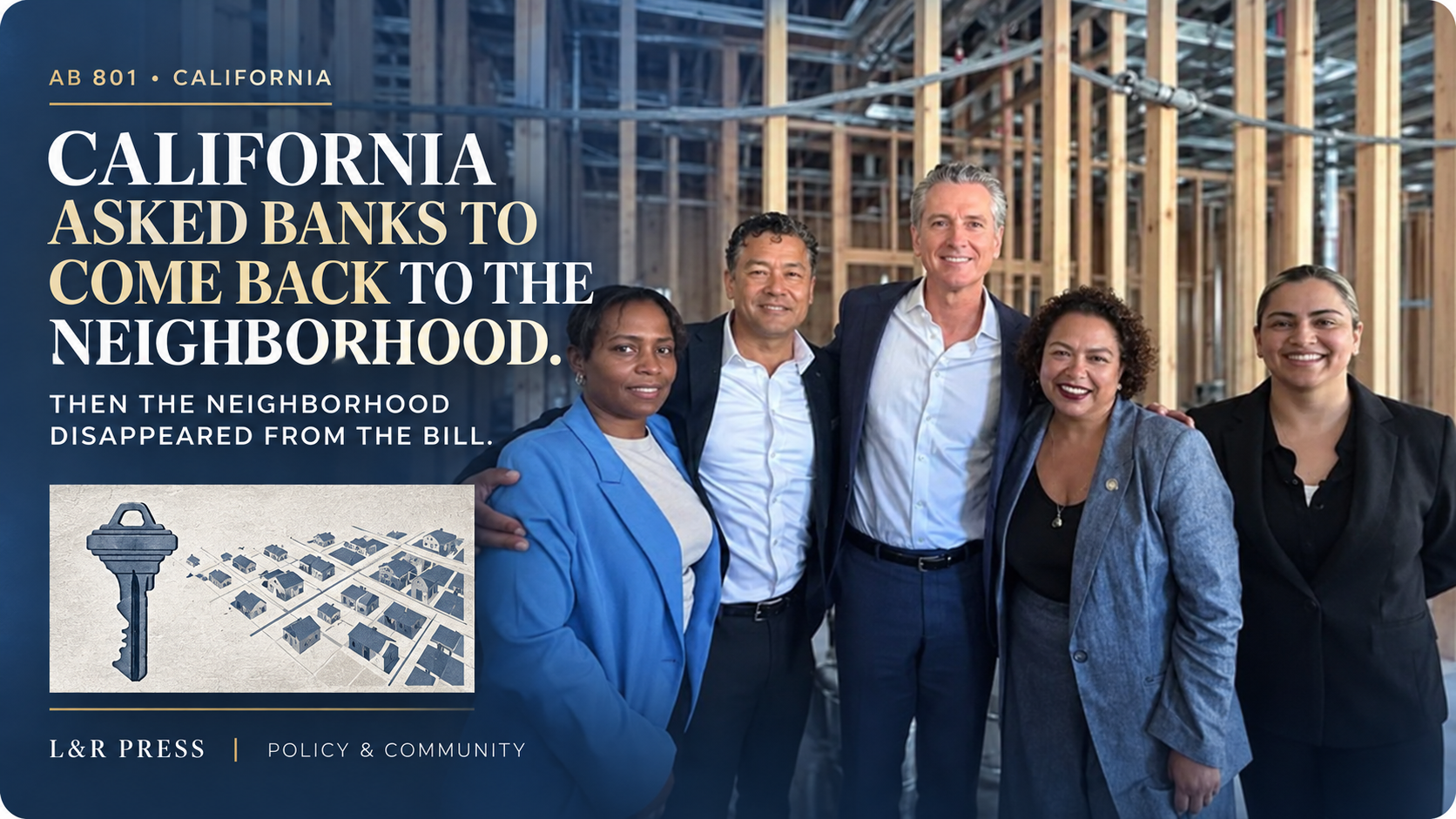
California has always had an interesting relationship with underserved communities.
We celebrate the music.
We celebrate the food.
We celebrate the athletes, artists, entrepreneurs and political movements.
We just occasionally forget to invest in the people who created all of it.
A neighborhood can produce culture for an entire country and still struggle to secure a grocery store, a business loan or enough financing to build affordable housing.
Apparently, everybody wants what the community creates.
They are just less enthusiastic about the community itself.
That contradiction sat at the heart of Assembly Bill 801.
When Assemblymember Mia Bonta introduced AB 801 in 2025, it was called the California Community Reinvestment Act. The proposal was built around a straightforward principle: financial institutions conducting substantial business in California should have an affirmative obligation to help meet the financial needs of the communities from which that business comes.
In ordinary language: if money regularly leaves a neighborhood through mortgage payments, fees, deposits and interest, some meaningful portion of opportunity should find its way back.
This should not have been a revolutionary concept.
It is basically the economic version of returning your mother’s food container. You received something valuable. You benefited from it. You are not supposed to keep the container forever.
The Bill California Originally Proposed
The original version of AB 801 would have applied California’s reinvestment expectations to covered banks, credit unions, qualifying mortgage lenders and certain money transmitters.
It would have required those institutions to help meet the financial-services needs of low- and moderate-income communities and communities of color where they maintained facilities or conducted substantial business.
The Department of Financial Protection and Innovation would have evaluated institutions at least once every three years and assigned public performance ratings ranging from “outstanding” to “substantial noncompliance.”
Institutions receiving poor ratings could have faced consequences when seeking state contracts, public deposits, branch approvals, mergers or other regulatory decisions. Repeated noncompliance could have produced administrative penalties.
The proposal also identified the kinds of investments that matter outside a bank’s executive suite: affordable housing, workforce housing, small-business technical assistance, community development financial institutions, broadband access, community land trusts, services for elderly and disabled residents, disaster recovery and nonprofit organizations working on economic development and wealth building.
That original framework recognized something America often pretends not to understand:
Capital is not neutral simply because the spreadsheet has no race.
Money follows systems. Systems follow decisions. And old decisions have remarkably long memories.
California’s own legislative findings acknowledged the history of redlining, exclusionary zoning, racially restrictive covenants, discriminatory mortgage policies and public projects that destroyed thriving Black communities.
The free market did not wake up one morning and independently decide where every highway, industrial zone and mortgage boundary should go.
Government helped draw the map.
Financial institutions helped finance the map.
Then everybody acted surprised when wealth accumulated on one side of it.
And Then Sacramento Did Something Very Sacramento
AB 801 passed both chambers in August 2026 and was presented to the governor on September 3.
But the enrolled bill was no longer the California Community Reinvestment Act.
The final legislation was renamed the California Fair Lending Examination Act.
The expansive reinvestment system was removed. The public ratings disappeared. The Community Reinvestment Fund disappeared. The explicit obligation to meet broader community financial needs disappeared.
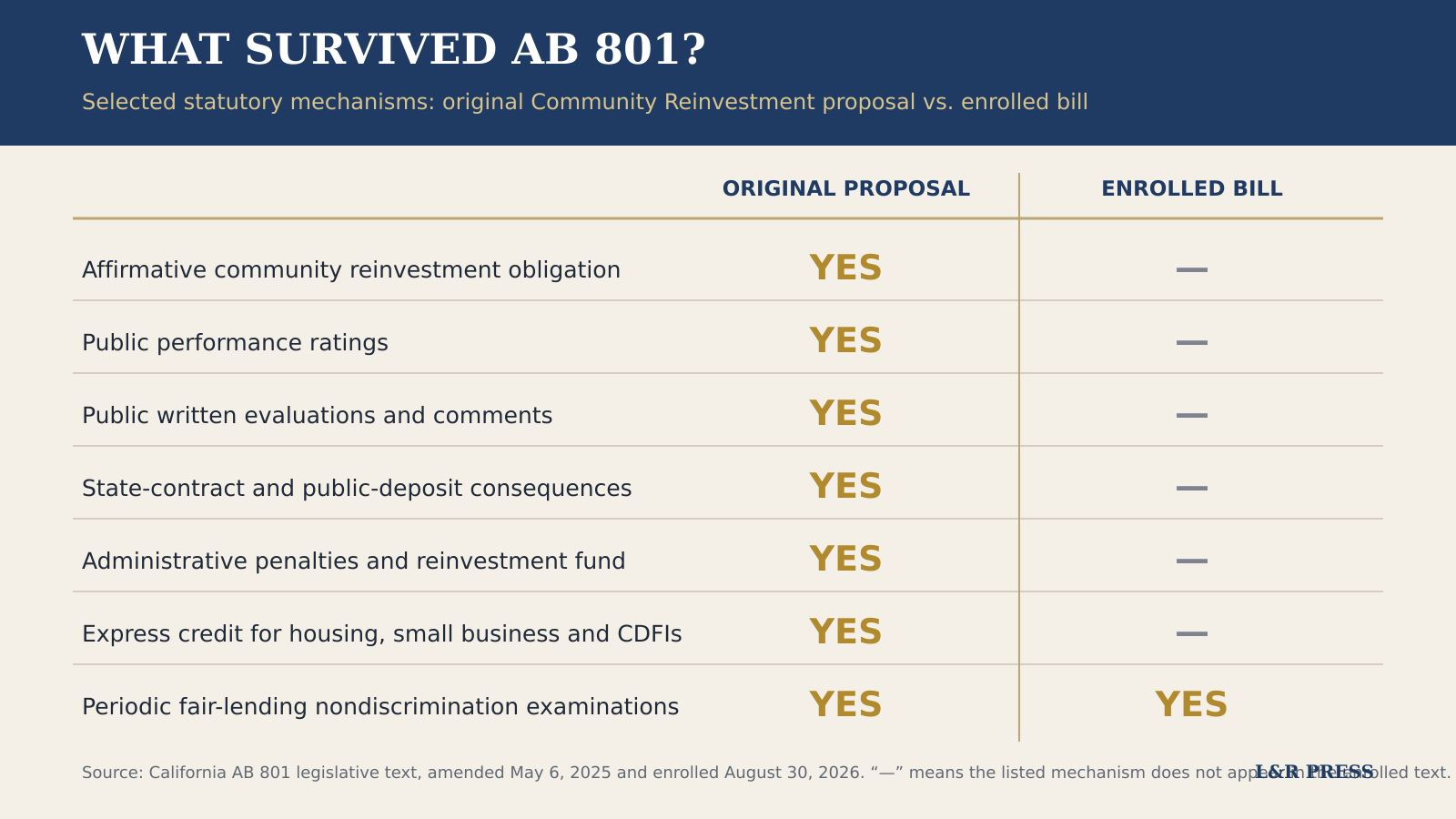
What remained would require California regulators, generally at least once every four years, to examine certain banks, credit unions, mortgage lenders and servicers for compliance with existing nondiscrimination laws applicable to mortgage lending.
That is still meaningful.
Discrimination in lending should be investigated. Violations should be corrected and enforced. A financial institution should not be allowed to treat fair-lending law like the complimentary reading material in a hotel room—technically present, rarely opened and apparently untouched for years.
But fair-lending enforcement and community reinvestment are not the same thing.
One asks whether institutions are breaking discrimination laws.
The other asks whether institutions benefiting from communities are affirmatively helping those communities build wealth, preserve housing, support small businesses and access responsible financial services.
The first attempts to stop harm.
The second attempts to create opportunity.
Communities need both.
A referee can prevent somebody from cheating. That does not build the stadium.
We Keep Exporting Our Greatest Assets
The debate over community reinvestment cannot stop with banks.
It also applies to us.
Underserved communities frequently produce extraordinary people and then teach them that success means leaving.
The bright student is told to study hard so she can get out.
The athlete is told to make it so he can move his family out.
The entrepreneur is congratulated when the business relocates somewhere with better capital, safer streets and stronger professional networks.
Every departure is treated as an individual victory.
Then twenty years later, we hold a community meeting to discuss why the neighborhood lacks doctors, attorneys, engineers, investors, experienced executives and thriving locally owned companies.
We exported the talent and kept the problems.

That is not a talent shortage.
That is a return-policy problem.
Successful people should be free to live wherever they choose. Nobody should be assigned a lifetime of unpaid community service because of the ZIP code printed on a childhood report card.
But leaving should not require forgetting.
Reinvestment can mean bringing capital back. It can also mean bringing knowledge, relationships, contracts, mentorship, technology, political influence and institutional discipline back.
You do not have to move into your childhood bedroom to help rebuild your childhood neighborhood.
You can invest in a local business.
You can place contracts with community-based vendors.
You can advise a nonprofit before it reaches a crisis.
You can help a young founder avoid the expensive mistakes you already survived.
You can serve on a board and actually do some work—which, depending on the board, may qualify as a radical act.
You can connect a community organization to the people who usually meet only after the community has been excluded from the decision.
The goal is not charity.
The goal is circulation.
Talent should circulate.
Capital should circulate.
Opportunity should circulate.
Communities become stronger when value does not travel in only one direction.
Reinvestment Must Be More Than a Ceremony
There is also a danger in turning “community reinvestment” into another elegant phrase that produces conferences, reports and professional photographs but very little reinvestment.
A bank should not receive moral credit for sponsoring a luncheon while denying the business owners seated at the luncheon access to responsible capital.
A corporation should not publish a community-impact report that is more financially secure than the organizations featured inside it.
A successful professional should not describe a neighborhood as “where I came from” as if it were a burning building they heroically escaped.
Where we come from is not merely part of our biography.
It can remain part of our responsibility.

That responsibility must also respect community leadership. Returning home does not mean arriving as the smartest person in the room.
People living inside underserved communities already understand their problems. They have often spent years designing solutions without the capital, infrastructure or institutional access needed to implement them.
The best outside partners do not arrive to rescue the community.
They arrive with resources, listen to the people already doing the work and help build the machinery required to execute.
The Work Continues Beyond AB 801
The final version of AB 801 may improve California’s ability to examine mortgage lenders for unlawful discrimination. That matters.
But California should remain honest about what was lost when the broader Community Reinvestment Act was removed.
The original proposal asked a larger question:
What do financial institutions owe the communities from which they generate business?
That question did not disappear simply because the language disappeared from the bill.
Neither did the deeper question for those of us who found education, success, relationships or financial stability beyond the communities where we began:
What do we bring back?

The playing field does not become level because a handful of talented people managed to climb off the uneven side.
At some point, capital has to return.
Expertise has to return.
Opportunity has to return.
And some of the brightest minds produced by our communities must decide that building those communities is not a consolation prize.
It may be the most important work available.
Editor’s note: AB 801 changed substantially during the legislative process. The proposal introduced as the California Community Reinvestment Act was replaced by the narrower California Fair Lending Examination Act before the bill was enrolled and presented to the governor on September 3, 2026. This article distinguishes between the original proposal and the enrolled legislation.
Sources: Enrolled text and legislative history of AB 801; original California Community Reinvestment Act proposal; background from Assemblymember Bonta and the bill’s co-sponsors.