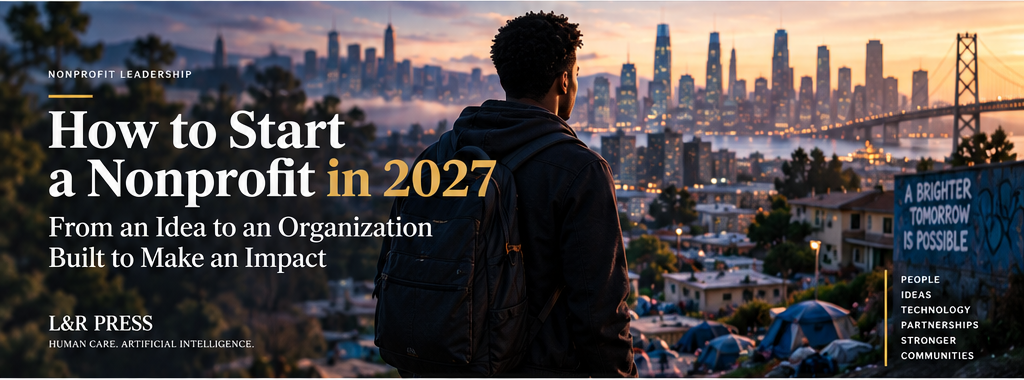
How can some of the wealthiest places in America also struggle with homelessness, failing schools, poverty, crime, food insecurity, and families who cannot afford to live where they work?
California alone has an economy larger than that of most countries. Its cities are home to some of the most valuable technology companies ever created, extraordinary universities, world-class hospitals, enormous concentrations of private wealth, sophisticated government institutions, and some of the greatest technical minds on the planet.
And yet people sleep outside within miles of companies worth hundreds of billions of dollars. Children attend schools struggling to prepare them for the economy being invented around them. Working families cannot afford housing. Foster youth still wait for permanent families. Neighborhoods continue confronting food insecurity, poverty, and cycles of violence.
The uncomfortable question is not whether America has enough resources to address these problems.
It is why we have not organized those resources well enough to solve them.
Why are technology companies, nonprofit organizations, universities, developers, doctors, attorneys, philanthropists, community leaders, and local governments not routinely sitting around the same table attacking these problems with the same urgency, technology, data, capital, and talent used to build billion-dollar companies?
That question should matter to anyone thinking about starting a nonprofit in 2027.
Because perhaps the opportunity is not simply to create another charitable organization.
Perhaps it is to build the missing institution capable of bringing extraordinary people and resources together around a problem society has learned to tolerate.
Starting a nonprofit is relatively straightforward. Building an institution capable of changing an outcome is considerably harder.
The legal process matters. A serious founder needs to understand incorporation, governance, tax exemption, compliance, and fundraising regulations. But those are the requirements for creating an organization. They are not the ingredients that make the organization consequential.
The better place to begin is with the problem.
Step One: Don’t Start With the Nonprofit. Start With the Problem.

The traditional nonprofit startup process often begins with a mission statement. We would begin one step earlier: investigate the problem.
The National Council of Nonprofits recommends research before incorporation, including determining whether there is a clear community need, considering startup costs and sustainability, understanding how impact will be demonstrated, and asking whether collaboration with an existing organization might be more effective than forming another one.
Suppose you want to help foster youth. “Helping foster youth” is not yet an institutional strategy.
What specifically needs to change? Perhaps young people are aging out of care without employment. Perhaps foster children are changing schools too frequently. Perhaps family reunification is delayed because information moves slowly between organizations. Perhaps foster parents need additional support before placements become unstable.
Those are different problems requiring different interventions, partners, measurements, and funding strategies.
The same discipline applies to food insecurity. Opening another food pantry may be valuable. But perhaps the deeper problem is that food already exists and distribution is inefficient. Or families do not know which benefits they qualify for. Or transportation prevents access. Or certain neighborhoods experience shortages at predictable times.
Understanding the actual bottleneck changes what you build. It also changes how funders perceive you.
A founder who says, “I care deeply about hunger,” has a cause. A founder who can say, “We studied food insecurity in these three neighborhoods, identified this recurring distribution failure, interviewed the people affected, developed an intervention, and established how we will measure whether it works,” is beginning to build an institution.
This broader philosophy is explored in We Have to Take Care of Our Own, where L&R Press argues that communities often possess extraordinary talent and resources but lack the infrastructure connecting them.
Before Filing Anything, Ask Whether Someone Else Should Be Your Partner
There is another possibility founders sometimes overlook: maybe you should not start a nonprofit. That is not failure.
If an existing organization already has the infrastructure, relationships, tax exemption, and credibility required to implement your idea, partnership may create more impact than creating another institution from scratch. A fiscal sponsor can sometimes provide another path.
The question is not, “How badly do I want my own organization?” It is: What structure gives this solution the greatest probability of succeeding?
Step Two: Define the Mission in Terms of an Outcome
Once you have identified a problem worth solving, the next challenge is turning aspiration into a measurable mission.
Consider the difference between “We help foster youth” and “We intend to increase the percentage of participating transition-age foster youth who enter employment, postsecondary education, or credentialed training within twelve months.”
The second version gives the organization something extraordinarily valuable: a definition of success.
At L&R Press, we take the concept further. Every new nonprofit should have a Mission Ladder™. The top is the outcome the organization exists to change. Underneath it are milestones, priorities, responsibilities, dependencies, evidence, funding requirements, research, and next actions.
The organization stops being a collection of good intentions. It becomes a mission with an execution architecture.
Step Three: Build the Founding Team Around What the Mission Requires

A nonprofit should not have a board simply because the paperwork requires one. Its founding leadership should increase the organization’s probability of accomplishing its mission.
Suppose your organization intends to develop housing for formerly homeless veterans. Who should be around the table? Someone who understands veterans. Someone who understands housing. Someone who understands real estate development. Someone who understands behavioral health. Someone who understands finance. Someone who understands government. Someone who understands fundraising. Someone with lived experience.
Suddenly the board is not ceremonial. It is strategic infrastructure.
The same philosophy applies regardless of mission. A nonprofit focused on AI education may need educators, employers, and technologists. A foster-care initiative may benefit from former foster youth, caregivers, child-welfare professionals, attorneys, and behavioral-health expertise.
Build the coalition the problem requires.
A Real Example: See the Need, Then Build the Response
Dolly Parton’s approach to philanthropy began with a problem she understood personally. Her father could not read or write, and that experience helped inspire what eventually became the Imagination Library.
Parton’s philosophy is strikingly practical: “I just see a need and if I can fill it, then I will.”
The program began in her home county in East Tennessee and grew into a much larger book-gifting infrastructure for young children. The lesson for a new nonprofit founder is not to copy the program. It is to notice the sequence: understand a problem personally, define a practical intervention, build partnerships around it, and create an institution capable of carrying the solution farther than one person could alone.
That is a much stronger starting point than beginning with the desire to own a nonprofit. Start with the need. Then determine what institution the solution requires.
Step Four: Form the Legal Organization
Only now do we reach the part many “how to start a nonprofit” guides put first.
The legal organization matters enormously. It simply should not be mistaken for the mission itself.
A nonprofit may be created under state law as a corporation, trust, or unincorporated association, although requirements differ. A typical charitable corporation will select an available name, file formation documents with the appropriate state authority, establish a board, adopt bylaws, and satisfy state-specific requirements.
The organization will also generally need an Employer Identification Number. For organizations seeking federal recognition under Section 501(c)(3), the governing documents must contain appropriate charitable purposes and related provisions.
Because nonprofit formation and charitable-solicitation requirements differ by state, founders should use qualified legal and accounting guidance where appropriate.
Step Five: Apply for Federal Tax-Exempt Recognition
Creating a nonprofit corporation under state law does not automatically make the organization federally tax exempt.
For many organizations seeking recognition under Section 501(c)(3), the relevant IRS application is Form 1023. Certain eligible organizations may qualify to use Form 1023-EZ. The determination letter is an important milestone, but it is not the finish line. Tax-exempt organizations continue to have filing and compliance responsibilities after recognition.
Nonprofit does not mean unregulated.
Step Six: Build Compliance Before You Start Chasing Money
New founders understandably want to get to fundraising quickly. But money introduces responsibilities.
State charitable-solicitation rules, periodic corporate filings, federal information returns, employment requirements, state tax obligations, conflicts-of-interest procedures, financial controls, and recordkeeping can all become relevant depending on the organization.
This is why L&R Press treats compliance as operational infrastructure, not paperwork to clean up later.
Step Seven: Build a Funding Strategy, Not a Grant-Application Habit
One of the most common mistakes new nonprofits make is treating grants as the business model. They are not.
A serious funding strategy may combine foundation grants, government funding, corporate philanthropy, individual giving, major gifts, contracts, earned revenue, sponsorships, and other sources appropriate to the mission.
But the larger issue is strategic. Do not begin with “Who gives grants?” Begin with: Who has a reason to care whether this outcome changes?
A hospital may care about food insecurity because nutrition affects health outcomes. An employer may care about workforce development because it cannot find qualified workers. A county may care about foster-youth employment because poor transitions create downstream social costs. A technology company may care about AI education because it needs future talent.
Now fundraising becomes partnership development.
Step Eight: Make the Organization Fundable Before Asking for Serious Money
Institutional funders rarely fund passion alone. They evaluate whether the organization appears capable of turning capital into outcomes.
A new nonprofit should therefore begin building funding readiness: a clearly defined problem, credible intervention, measurable outcomes, realistic budget, qualified leadership, responsible governance, appropriate compliance, compelling case for support, evidence of community need, partnership strategy, and a pipeline of potential funders.
Increasingly, another element belongs on that list: a differentiated solution.
In The Next Funding Advantage for Nonprofits Will Be Artificial Intelligence, we argue that community organizations should not merely tell funders they “use AI.” They should demonstrate how responsible AI helps them solve a problem better.
Step Nine: Build Technology Into the Organization From Day One

This may be one of the largest differences between starting a nonprofit in 2027 and starting one twenty years ago.
A small nonprofit no longer needs to accept operating like a small institution. Artificial intelligence can expand research capacity, identify funding opportunities, analyze information, support program design, organize institutional knowledge, reduce administrative work, and help teams recognize patterns earlier.
But organizations serving vulnerable populations should establish clear boundaries around AI, privacy, confidential information, human oversight, and consequential decisions.
Technology should increase the capability of professionals. It should not quietly replace their judgment.
That principle is foundational to L&R Press’s Real-Time Mission Management™. Approved meetings and operational conversations can become inputs into a continuously evolving system. AI can identify bottlenecks, conduct research, develop Mission Recommendations™, update priorities, and track dependencies while human professionals remain responsible for consequential decisions.
Step Ten: Operate Like the Institution You Hope to Become
The first year creates habits that can remain with an organization for decades.
If the founder personally remembers every deadline, the organization develops founder dependency. If nobody measures outcomes, storytelling substitutes for evidence. If board meetings are ceremonial, governance becomes ceremonial. If grant opportunities determine the strategy, the organization becomes reactive. If information disappears after meetings, institutional knowledge never compounds.
Build differently from the beginning.
Every meeting should change something. Every commitment should have an owner. Every major goal should have evidence attached to it. Every funding opportunity should connect to the mission. Every program should produce learning. Every failure should improve the operating system. Every success should become institutional knowledge.
The Real Work Begins After the IRS Says Yes
Receiving 501(c)(3) recognition can feel like an enormous milestone. It is.
But it does not feed anyone. It does not educate a child. It does not house a family. It does not reunify a foster child. It does not create a job. It does not change a neighborhood.
It gives you an institutional vehicle through which those things may become possible.
That is where founders discover the difference between starting a nonprofit and building one.
We Are Looking for People Working on Problems That Shouldn’t Still Exist
At L&R Press, we are increasingly interested in a particular kind of nonprofit founder.
Not necessarily someone with nonprofit experience. Not necessarily someone with wealthy donors. Not necessarily someone who already understands grant writing.
We are looking for people who understand a problem deeply enough to believe there has to be a better way.
Educators who know why children are falling behind. Former foster youth who understand what the system misses. Parents who have experienced food insecurity. Returning citizens who know where reentry programs break down. Doctors who see preventable health problems repeatedly. Developers who believe housing can be built differently. Technologists who believe powerful tools should reach underserved communities. Attorneys who see systemic barriers everyone else has learned to tolerate.
Those people may possess something more valuable than nonprofit expertise. They possess proximity to the problem.
Through the L&R Press Nonprofit Incubator, we help participating organizations develop strategy, compliance, funding infrastructure, institutional relationships, grant capacity, and Real-Time Mission Management™ around the mission they are attempting to accomplish.
The founder does not have to arrive with an institution. The founder has to arrive with a problem worth solving.
So, How Do You Start a Nonprofit in 2027?
Yes, incorporate correctly. Build the board. Get the EIN. Create the bylaws. Apply for the appropriate tax exemption. Understand fundraising registration. Establish financial controls. Build a funding pipeline. Measure outcomes. Maintain compliance.
Those things matter.
But do not confuse creating the legal organization with creating the institution.
The better sequence is to find the problem, understand it better than anyone else, listen to the people experiencing it, determine what existing approaches are missing, design a better intervention, assemble the people required to execute it, define what success means, and then build the legal, financial, technological, and operational infrastructure capable of carrying that mission.
Somewhere right now, someone understands why a child is still hungry. Why a student is falling behind. Why a foster child is still waiting. Why a parent cannot find stable employment after incarceration. Why a family cannot afford housing. Why a community keeps receiving programs but not progress.
That person may not yet know how to form a board. They may never have written a grant. They may not understand federal tax law. They may not know anyone at a foundation.
Those things can be learned.
L&R Press can guide and manage every stage of starting your nonprofit, from defining the mission and assembling the board to coordinating formation, compliance, funding readiness, technology, and the operating systems required to grow. We can also implement Real-Time Mission Management™ from the beginning, giving your organization the structure, execution capacity, and institutional discipline to operate at scale while the funding pipeline develops and capital arrives.
What is considerably harder to manufacture is the conviction that a problem everyone else has learned to tolerate does not have to remain that way.
If that describes you, perhaps the first question is not, “How do I start a nonprofit?” Perhaps it is:
What am I prepared to change?
And from there, we can build.
L&R PRESS NONPROFIT INCUBATOR
Have a mission you’re ready to build?
We help mission-driven leaders build the strategy, funding infrastructure, compliance systems, relationships, and execution capacity required to turn ambitious ideas into measurable impact.