Is Oakland a Costco City?
Oakland residents already spend hundreds of millions of dollars at Costco. The question is whether the city will organize to bring the jobs, revenue and ownership benefits home.
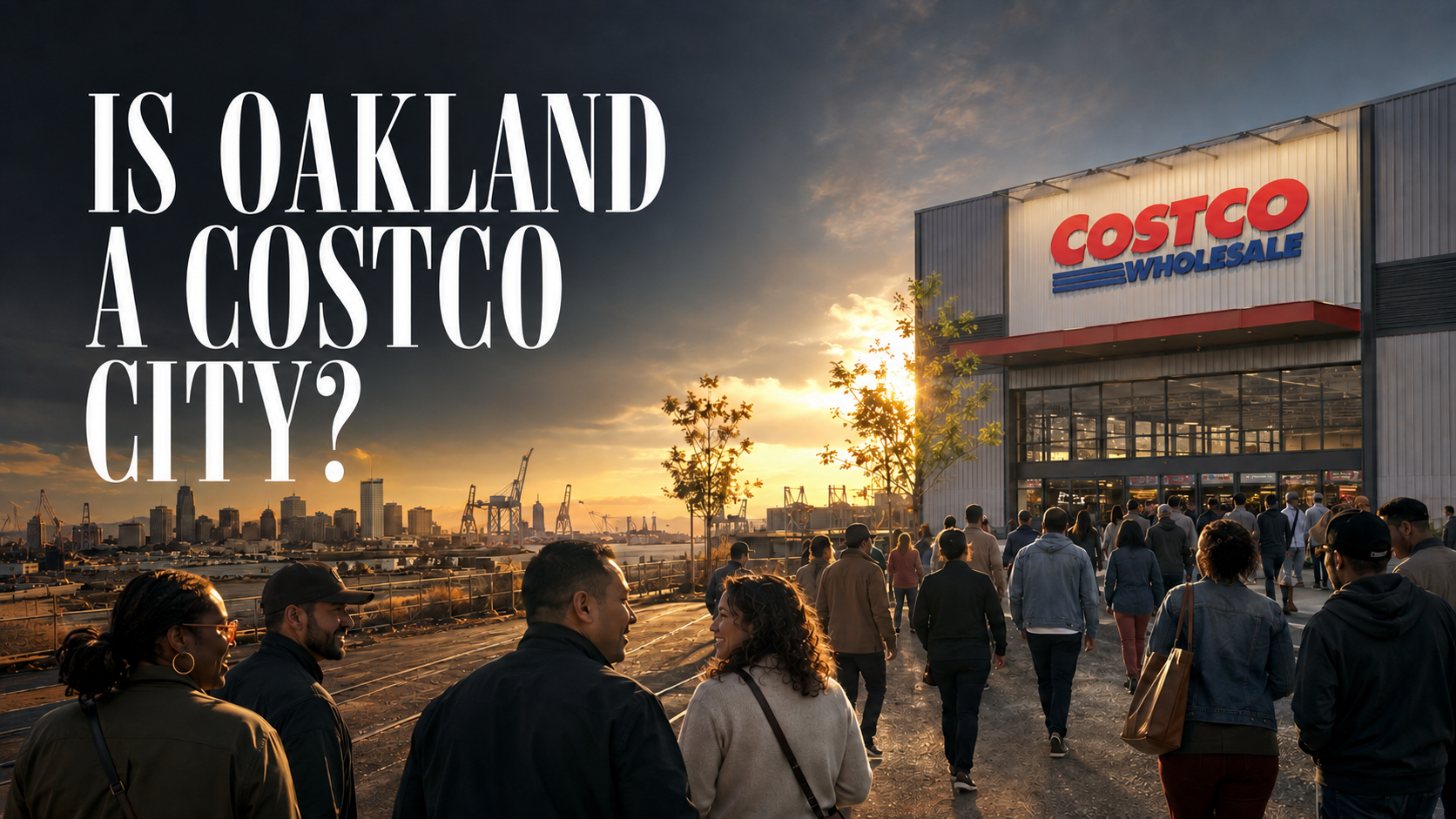
Oakland leadership is considering bringing Costco to Oakland. Oakland has already demonstrated the consumer demand. The question is whether residents will organize to bring the ownership benefits home.
In 2026, the Oakland City Council approved a 24-month exclusive negotiation agreement with Costco Wholesale Corporation for city property at 101 Admiral Robert Toney Way and 2308 Wake Avenue. Costco’s exclusivity is conditioned on a $300,000 payment, and the agreement allows two additional six-month extensions at $25,000 each. The approval begins a negotiation. It does not approve construction, guarantee a warehouse or establish an opening date.
Oakland does not need to be persuaded to shop at Costco. Oakland is already doing it.
According to figures cited from a city report, roughly 90,000 Oakland residents hold Costco memberships and spend an estimated $270 million at the retailer each year. Because Oakland has no warehouse, much of that spending crosses municipal lines into San Leandro, Richmond and San Francisco.
That makes the proposed Costco at the former Oakland Army Base unusually easy to understand from a consumer’s perspective. The harder question to answer is why Oakland deserves a Costco when its residents have been willing to travel and spend their dollars in ways that improve other communities with Costcos.
The answer cannot be that Oakland is entitled to another company’s investment. Cities earn major investment by demonstrating demand, creating workable development conditions, protecting customers and employees, and organizing residents behind a clear public-benefit vision. Oakland has already proved the demand. It must now prove that it is prepared to convert demand into durable local value.
The strongest case for Costco is already visible: Oakland residents shop there. Now residents must organize around a clear public-benefit vision.
A serious pro-Costco case should describe the opportunity with confidence while insisting that the final agreement converts scale into measurable public benefit. Jobs must be accessible to Oakland residents. Revenue assumptions must survive scrutiny. Environmental remediation and traffic mitigation must be enforceable. Neighborhood businesses must have a way to participate in the new commercial activity.
The opportunity already in motion
Demand is not the missing ingredient
Consumers versus owners
Oakland residents currently participate in Costco’s economy as consumers. They buy memberships, fill carts and purchase fuel. But communities containing the warehouses participate in a second capacity: they host the jobs, capture applicable local tax revenue, attract linked trips and gain leverage for surrounding development.
That is the consumer-versus-owner distinction. It does not mean the city would own Costco. It means Oakland would host and negotiate around the productive asset instead of merely consuming what that asset produces elsewhere.
When residents travel to San Leandro, Richmond or San Francisco for Costco, the products return to Oakland. Most of the place-based economic benefits do not. Employees report to workplaces in those communities. Taxable transactions are recorded there. Nearby restaurants and businesses receive some of the secondary visits. Public agencies there gain revenue and commercial data supporting future investment.
Oakland should want more than access. It should want proximity to production, employment and investment.
The spillover benefits and why they are not automatic
Large warehouses and factories can improve the economic trajectory of struggling communities. A new facility creates a primary layer of jobs, construction activity and taxable commerce. Those gains can then produce secondary effects: employees spend locally, suppliers serve the facility, nearby parcels become more attractive and governments gain additional resources for services and infrastructure.
Economists call these multiplier or spillover effects. They are often described politically as trickle-down benefits. The important point for Oakland is that the benefits become stronger when local policy deliberately connects the new anchor to residents and surrounding neighborhoods.
Without local hiring, safe transportation, infrastructure planning and community-business participation, a warehouse can become an island: busy inside its property line but weakly connected to the people living around it. Oakland’s job is to prevent that outcome.
Four reasons to bring the spending home
What a local Costco could change
High-quality retail jobs
Costco’s 2025 annual report states that the average hourly rate for its United States hourly employees reached approximately $32 at the end of the fiscal year. At that time, entry-level wages were at least $20, and the company reported offering broad employee benefits. Oakland’s estimate of roughly 400 jobs gives the city a credible platform from which to demand local recruitment, apprenticeships, promotion pathways and transparent reporting.
Revenue that currently benefits other cities
Oakland’s publicly reported estimate is approximately $3 million in annual revenue from a future warehouse. That estimate should be independently tested against any tax-sharing, infrastructure or remediation concessions, but California comparisons show why cities compete for Costco developments.
Household and small-business purchasing power
A local warehouse would shorten trips for existing members and give Oakland restaurants, caterers, childcare operators, nonprofits and other small organizations a nearby wholesale purchasing option. Strong planning must also address transit, membership fees, bulk quantities and household storage limitations.
A viable use for a difficult parcel
The North Gateway property has remained undeveloped for years. City documents describe deed restrictions that prohibit residential housing without extensive toxic mitigation and a state waiver. Costco offers a potentially viable commercial use for land carrying unusual environmental, legal and infrastructure constraints.
From paychecks to neighborhoods
How the benefits could travel beyond the warehouse
When Oakland residents gain stable jobs close to home, they spend less time and money commuting. Their paychecks circulate through rent, mortgages, childcare, food, transportation, personal services and local entertainment. Developers see stronger evidence of demand, and local businesses gain customers who are present in the neighborhood before and after work.
- A major employer creates hundreds of direct jobs.
- Employees retain more income and time by working closer to home.
- More household spending circulates through Oakland businesses and housing.
- Nearby commercial and residential demand becomes easier to finance.
- New development expands the tax base and supports additional public services.
No single warehouse can repair Oakland’s housing market or guarantee neighborhood prosperity. New development can also create displacement pressure if housing production and tenant protections do not keep pace. The city should connect Costco’s employment opportunity to broader housing, transportation and small-business strategies rather than treating the warehouse as a self-contained victory.
A warehouse is an anchor, not a complete economic strategy. The public value comes from what Oakland builds around it.
The cost of exporting Oakland loyalty
Oakland keeps consuming. Other cities receive the spending.
Oakland residents understand the consumer-versus-owner divide because they have already lived through it in professional sports. The Warriors moved from Oakland to San Francisco. The Raiders moved to Las Vegas. The Athletics left Oakland after the 2024 season and began playing temporarily in West Sacramento while pursuing a permanent Las Vegas stadium.
Those moves did not erase Oakland residents’ emotional interest in the teams. What changed was where the economic activity occurred. Tickets, parking, food, hospitality and surrounding entertainment spending increasingly flowed to San Francisco, Sacramento and Las Vegas. Oakland retained much of the cultural loyalty while losing the physical venues that concentrated commerce.
Oakland also lost its only In-N-Out Burger in 2024. The restaurant closed despite being busy and reportedly profitable after the company cited repeated crime and safety problems affecting customers and employees. Consumer demand alone does not guarantee that a business will remain in a city. A city must also provide conditions in which major employers believe they can invest, operate safely and grow.
Modernization is not abandoning Oakland
Oakland residents should become more vocal in supporting the modernization of their city. Modernization does not require erasing Oakland’s identity, handing public land to private interests without accountability or accepting every proposed development. It means refusing to let nostalgia become a substitute for investment.
A modern Oakland can protect longtime residents while welcoming employers. It can preserve culture while building new infrastructure. It can demand environmental repair while supporting commercially viable uses. It can insist on community benefits without making development practically impossible.
California comparison
The public agreement determines who captures the value
The California communities discussed earlier establish that Costco can generate substantial recurring revenue and help activate difficult development areas. Oakland should study them for more than proof that the opportunity is valuable. Each also reveals how the structure of a public agreement determines who ultimately receives that value.
The comparison below converts those examples into negotiating lessons. San Dimas demonstrates the durability of the revenue. Roseville shows how a warehouse can support infrastructure and unlock a growth area. Brea warns that impressive revenue can still leave the public questioning how proceeds are divided. Oakland enters negotiations with the strongest advantage of all: a large customer base that already exists.
| COMMUNITY | DOCUMENTED LESSON | OAKLAND IMPLICATION |
|---|---|---|
| San Dimas | More than $23.3 million in Costco-center sales-tax remittances through June 2025 under a long-running agreement. | Large recurring retail volume can become a durable municipal revenue stream. |
| Roseville | Second warehouse projected to generate about $2.5 million annually in sales tax plus property tax and infrastructure support. | A warehouse can support fiscal diversification and a difficult growth area. |
| Brea | City projected about $50.2 million in local sales-tax revenue over 50 years, but a large developer share generated controversy. | Oakland must scrutinize subsidies and preserve a fair public return. |
| Oakland | Residents already spend an estimated $270 million annually at Costco outside the city. | The case is about recapturing an established local demand base. |
These cases do not prove Oakland’s exact return. They show that Costco can materially affect a city’s revenue base and that the negotiated agreement determines how much of the benefit reaches the public.
Support the project. Negotiate the proof.
Supporting Costco does not require Oakland to accept a blank check. It means moving the project forward while insisting that the final agreement translates consumer demand into enforceable commitments. Six priorities should define what residents and city leaders expect before the deal is complete.
Local hiring
Establish Oakland recruitment targets, accessible application support, workforce reporting and advancement pathways.
Fiscal return
Publish independent revenue estimates, the value of every subsidy or concession and Oakland’s projected net return under multiple sales scenarios.
Environmental repair
Require a publicly reviewable remediation plan, clear responsibility for cost overruns and continuing air, soil and groundwater safeguards.
Traffic and access
Model truck, customer and fuel-station traffic, fund necessary intersection and transit improvements, and protect nearby residential streets.
Neighborhood participation
Establish procurement, workforce, vendor and membership initiatives connecting West Oakland residents and businesses to the project.
Performance accountability
Translate promises into milestones, named owners, reporting deadlines and remedies when commitments are missed.
From support to civic power
How residents can help make Costco happen
The exclusive negotiation agreement is an opening, not a finish line. Residents who support the project should organize around a specific message: complete the negotiation, protect West Oakland and make the public benefits enforceable.
Track File 26-0762
Use Oakland’s Legistar system and City Council meeting pages to follow staff reports, environmental review, development terms and votes.
Subscribe before the next agenda appears
Subscribe to City Council and committee notices now rather than learning about major decisions after the public-comment window is nearly closed.
Contact the full decision chain
Write the District 3 council office, at-large council member, mayor and relevant economic-development staff with specific support for Costco, local hiring, remediation, traffic planning and a fair fiscal return.
Submit public comment and speaker cards
A short factual comment tied to the active file is more useful than a general social-media post.
Build a visible coalition
Neighborhood associations, labor groups, small businesses and existing Costco members can issue a joint statement identifying both support and required community benefits.
Bring receipts
Document how often residents travel to other Costco locations, what they spend and whether their businesses use Costco for supplies.
Support responsible modernization
Demand credible safeguards, but distinguish fixable project conditions from blanket opposition to investment.
Measure promises after approval
If a final project is approved, maintain a public scorecard for local hiring, wages, remediation, construction milestones, traffic commitments and city revenue.
The residents most likely to shape the final agreement are not merely the loudest. They are the ones who remain organized through every technical stage.
The larger lesson
Oakland can keep its identity and build its future
Cities often treat economic-development decisions as a contest between optimism and opposition. That is too crude. Oakland can be ambitious about attracting investment and exacting about public value at the same time.
The proposed Costco offers four aligned benefits. It could bring high-quality jobs closer to residents, retain a portion of spending currently leaving the city, improve access to household and business essentials, and activate a difficult former military parcel. Few developments begin with such visible proof of demand.
The responsible pro-Costco position is not a blank check. It is a mandate to complete the negotiation, verify the economics, protect West Oakland and make every important community commitment enforceable.
Oakland residents have already voted with their membership cards. They now have to participate as something more powerful than consumers. They have to act like stakeholders in the future of their city.
Your organization already has signals. The question is whether they become action.
L&R Press combines proprietary research software, AI Specialists and human consulting oversight to turn complex priorities into a living Mission Ladder.
Evidence behind the analysis
- City of Oakland, File 26-0762, Costco Exclusive Negotiation Agreement, adopted July 7, 2026.
- City of Oakland, File 26-0264 and November 24, 2025 agenda report concerning the former Oakland Army Base North Gateway parcel.
- San Francisco Chronicle, reporting city estimates for Costco membership, spending, jobs and revenue, June 23, 2026.
- Costco Wholesale Corporation, 2025 Form 10-K, employee compensation and benefits disclosures.
- City of San Dimas, Tax Sharing Revenue Agreement status through June 30, 2025.
- City of Roseville, Government Code Section 53083 summary report for the west Roseville Costco project.
- City of Brea, December 9, 2025 economic-development agreement memorandum.
- California Department of Tax and Fee Administration, California sales and use tax guidance.
- City of Oakland, City Council meeting information, public-comment instructions and meeting notices.
- Athletics relocation reporting and team announcement concerning temporary play in West Sacramento beginning in 2025.
- In-N-Out statement and contemporaneous reporting concerning the permanent closure of its Oakland restaurant in March 2024.