Nonprofit Fundraising & Real-Time Mission Management™
Real-Time Mission Management™: The Future of Nonprofit Fundraising
Why the most successful nonprofits do not just buy fundraising software. They build execution systems.
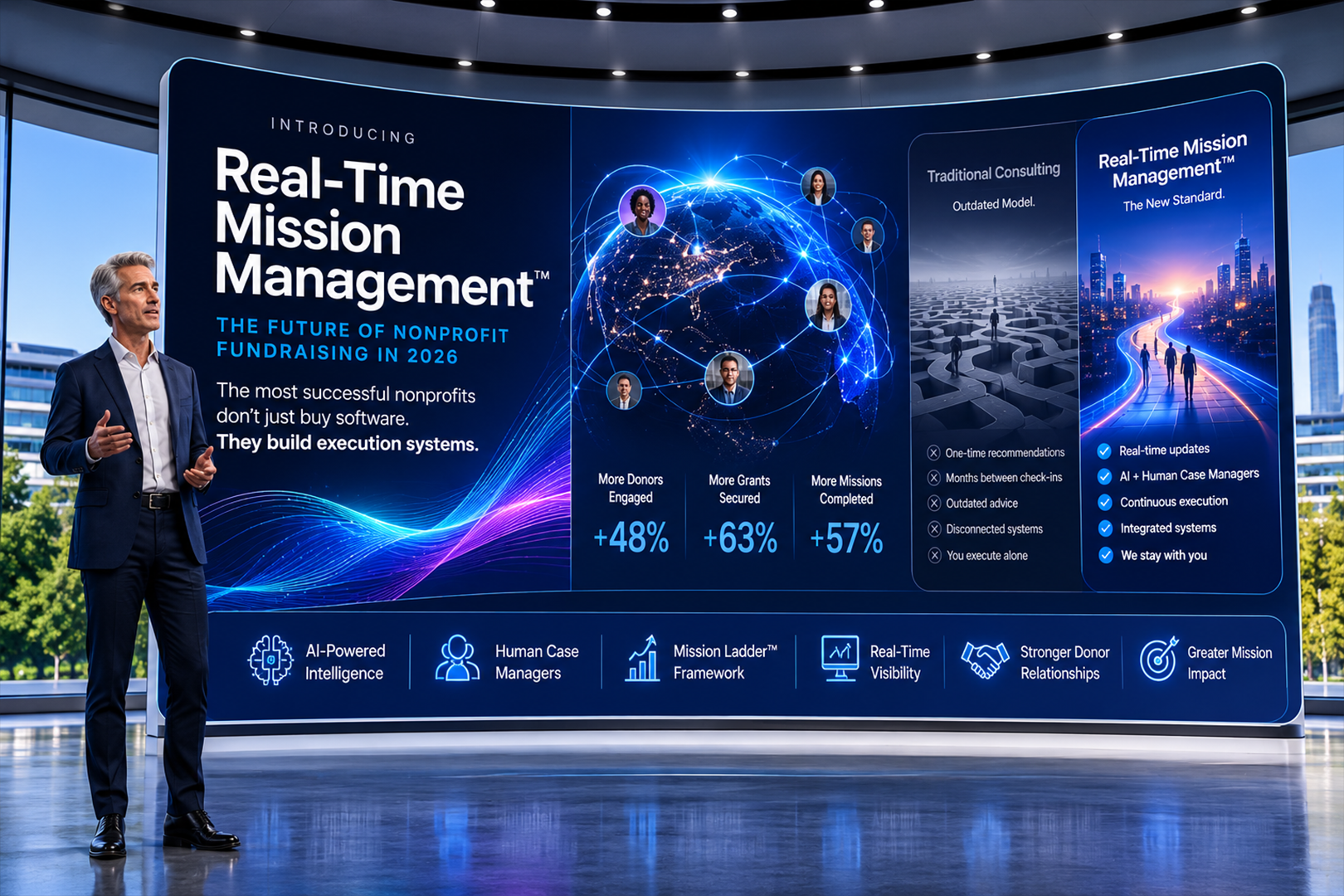
For years, the nonprofit sector has been told the same story.
If donations slow, buy a better donor database. If major gifts decline, purchase a wealth-screening platform. If volunteers disappear, implement a new CRM. If grant funding becomes more competitive, subscribe to another grant database.
The nonprofit technology market has responded with thousands of software platforms promising to solve nearly every operational challenge imaginable.
Donor management systems. Grant databases. Volunteer management platforms. Peer-to-peer fundraising software. Event ticketing. Email marketing. Artificial intelligence.
Yet many nonprofit executives continue asking the same question: Why does fundraising still feel so difficult?
The answer may have less to do with software than with execution.
The Hidden Problem Technology Does Not Solve
Fundraising is often portrayed as a technology problem. In reality, it is an organizational coordination problem.
Consider what happens after a board meeting. The executive director leaves with new priorities. Development staff identify potential donors. A grant writer begins researching funding opportunities. The marketing team starts planning a campaign. Board members volunteer to make introductions.
Everyone leaves motivated. Then reality returns.
Emails pile up. Meetings get rescheduled. Grant deadlines shift. Donor conversations stall.
Three weeks later, leadership realizes that despite everyone's good intentions, momentum has quietly disappeared. Nothing catastrophic happened. No single decision failed. The organization simply lost synchronization.
This is exactly where execution gaps after strategy meetings begin to compound across a nonprofit organization.
L&R Press Insight
Fundraising stalls when strategy, people, deadlines, and accountability fall out of sync.
The problem is rarely a lack of tools. It is the absence of a continuous system that keeps the mission moving after the meeting ends.
The Software Explosion
Nonprofits now have access to more fundraising technology than at any point in history. Organizations can automate donor acknowledgments, analyze giving patterns, schedule social media campaigns, manage volunteers, process online donations, and identify prospective major donors using artificial intelligence.
These tools are valuable. But software does not execute strategy. Software records activity. People create momentum.
That is why many organizations discover that purchasing another fundraising platform does not necessarily produce more fundraising. Instead, they inherit another dashboard, another login, and another system someone has to remember to update.
More software does not automatically create more execution.
Why Traditional Consulting Falls Short
Consulting has traditionally attempted to solve this problem through strategic planning. A consulting team interviews leadership, reviews financial statements, conducts stakeholder meetings, produces recommendations, and presents a roadmap.
Then the engagement ends.
Traditional consulting tells organizations what they should do and then leaves the client on their own to execute. Months later, consultants may return to evaluate progress, but by then the organization has changed.
New funding opportunities have emerged. Staff members have transitioned. Grant priorities have shifted. Board leadership has evolved.
Recommendations that were highly relevant six months earlier may no longer reflect today's reality. The advice was not necessarily wrong. It simply became outdated.
Enter Real-Time Mission Management™
Rather than treating fundraising as a sequence of isolated projects, Real-Time Mission Management™ approaches nonprofit growth as a continuous process.
Instead of asking, “What should the organization do this year?” it asks, “What is the next most important action the organization should take today?”
That distinction changes everything.
Real-Time Mission Management™ combines experienced human case managers with AI-powered technology to help organizations maintain continuous visibility into their priorities, funding opportunities, and operational progress.
Rather than replacing leadership, technology supports it. Artificial intelligence identifies patterns, summarizes information, tracks milestones, and surfaces opportunities. Human case managers provide judgment, accountability, relationship management, and strategic guidance. Together, they create something traditional consulting rarely provides: continuous execution support.
Real-Time Mission Management™
Relevant advice. Real-time updates. Continuous execution support.
L&R Press combines AI-powered technology with experienced human case managers to help organizations organize, fund, and execute complex initiatives without disrupting day-to-day operations.
Explore Real-Time Mission Management™The Mission Ladder™
At the center of this philosophy is the Mission Ladder™. Every organization has a mission. The problem is that missions often remain too abstract.
Raise more funding. Expand programs. Increase community impact.
These are worthwhile goals, but they rarely explain what should happen next.
The Mission Ladder™ transforms ambitious goals into visible, sequential milestones. Every completed task creates momentum. Every milestone reveals the next priority.
Leadership Always Understands
- What is complete
- What is currently underway
- What is blocked
- What comes next
Instead of revisiting strategy once or twice a year, organizations continuously refine execution as new information becomes available.
Why AI Changes Everything
Artificial intelligence has dramatically reduced the cost of administrative work. Meeting notes can be summarized automatically. Grant requirements can be analyzed in seconds. Donor communications can be drafted almost instantly. Performance dashboards can update continuously.
But AI alone cannot build trust. It cannot navigate sensitive board dynamics. It cannot strengthen relationships with major donors. It cannot replace experienced leadership.
That is the same reason AI alone cannot scale a great business idea without experienced people guiding execution.
The organizations most likely to thrive in the coming decade will not simply adopt artificial intelligence. They will combine artificial intelligence with experienced people who understand how missions succeed.
Technology accelerates execution. People create impact.
A Different Way to Think About Fundraising
Fundraising is not merely about asking for money. It is about building organizational confidence.
Donors invest in organizations they believe can execute. Grantmakers fund organizations they trust to deliver measurable outcomes. Corporate sponsors seek reliable partners capable of managing complex initiatives.
Execution becomes a fundraising strategy. Organizations that consistently follow through become easier to fund.
For proof that this model can coordinate real work across organizations and geographies, review the cross-border philanthropic coordination case study.
Beyond Fundraising Software
For many nonprofits, the next competitive advantage will not come from purchasing another fundraising platform. It will come from creating better organizational alignment.
When leadership, fundraising, operations, marketing, and partnerships remain synchronized through real-time execution, fundraising becomes less reactive and more intentional. Technology becomes an enabler rather than another responsibility.
The Future of Nonprofit Growth
As artificial intelligence reshapes every industry, nonprofits face an important decision.
They can continue adding disconnected software platforms. Or they can build systems that connect strategy, people, funding, and execution into a single operational rhythm.
That is the philosophy behind Real-Time Mission Management™.
Not replacing nonprofit leadership. Strengthening it.
Not replacing human relationships. Supporting them.
Not replacing fundraising. Helping organizations execute the work that inspires people to invest.
About L&R Press
L&R Press helps nonprofits, startups, public agencies, and mission-driven organizations organize, fund, and execute complex initiatives through Real-Time Mission Management™.
By combining AI-powered technology with experienced human case managers, the L&R Press Incubator and Client Portal provide organizations with continuous execution support, real-time operational visibility, and funding strategies designed to help missions move from vision to measurable impact.
What’s next
Turn fundraising strategy into continuous execution.
Choose the Incubator if you are launching something new, or use the Client Portal to bring Real-Time Mission Management™ into an existing organization.